Client Success Stories
Real academics. Different challenges. Tangible outcomes.
There is no single reason academics come to work with me. Some are struggling to publish consistently. Some have a book or thesis they cannot get finished. Others are already successful academics who want to become more strategic about what they publish, how they work and where their career is going.
What matters is what changes as a result.
These stories show what that change can look like across different disciplines, career stages and institutions. Find the situation that looks most like yours - and see what happened next.
They came for one thing
Better writing
Accountability
Feedback
A finished paper
Career advice
→
→
→
→
→
…They built something bigger
a publication strategy
a sustainable writing practice
better academic judgement
a publication strategy
a long-term academic strategy
Find Someone Like You





Featured Client Stories
Publishing Journal Articles
Laura: From a blank page to two accepted articles
Background
Laura was an academic with research to publish but very little recent publication output.
The problem
When she started working with your materials, she was effectively staring at a blank page with an article deadline only a couple of months away.
During coaching
She began with 5K in 20 and moved into Master Journal Article Writing, using the structured writing process to move the paper from idea through drafting and completion.
Outcome
The article was accepted. More importantly, it became her second accepted article in approximately six months, after a period in which she felt she had had very little to show for her work.
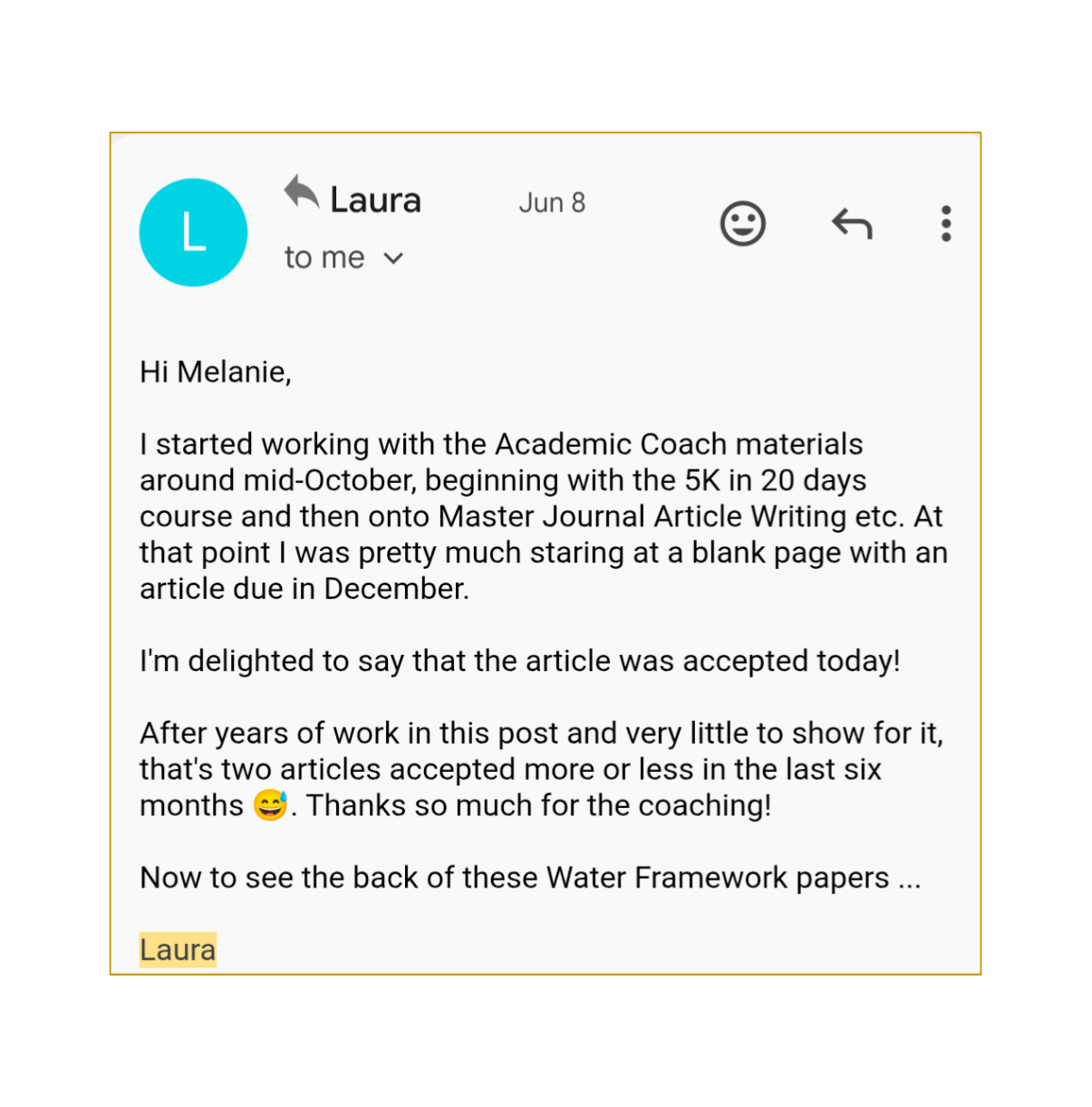
“At that point I was pretty much staring at a blank page with an article due in December. I'm delighted to say that the article was accepted today!”
- Laura
Chiara: The paper she nearly withdrew
Background
Chiara was an early-career academic who had written a paper and was preparing to submit it.
Problem
A final literature search produced a newly discovered paper that appeared, at first sight, to have done exactly what she had done. She panicked and was ready to contact the editor and withdraw her own paper.
During coaching
Chiara brought the problem to a live writing session. In a five-minute conversation, we looked at what the other paper actually did, why it was not the same contribution, and how she could use the new research to strengthen the positioning of her own paper rather than abandon it. She made the changes and submitted.
Outcome
Both peer reviewers recommended acceptance with only very minor amendments.
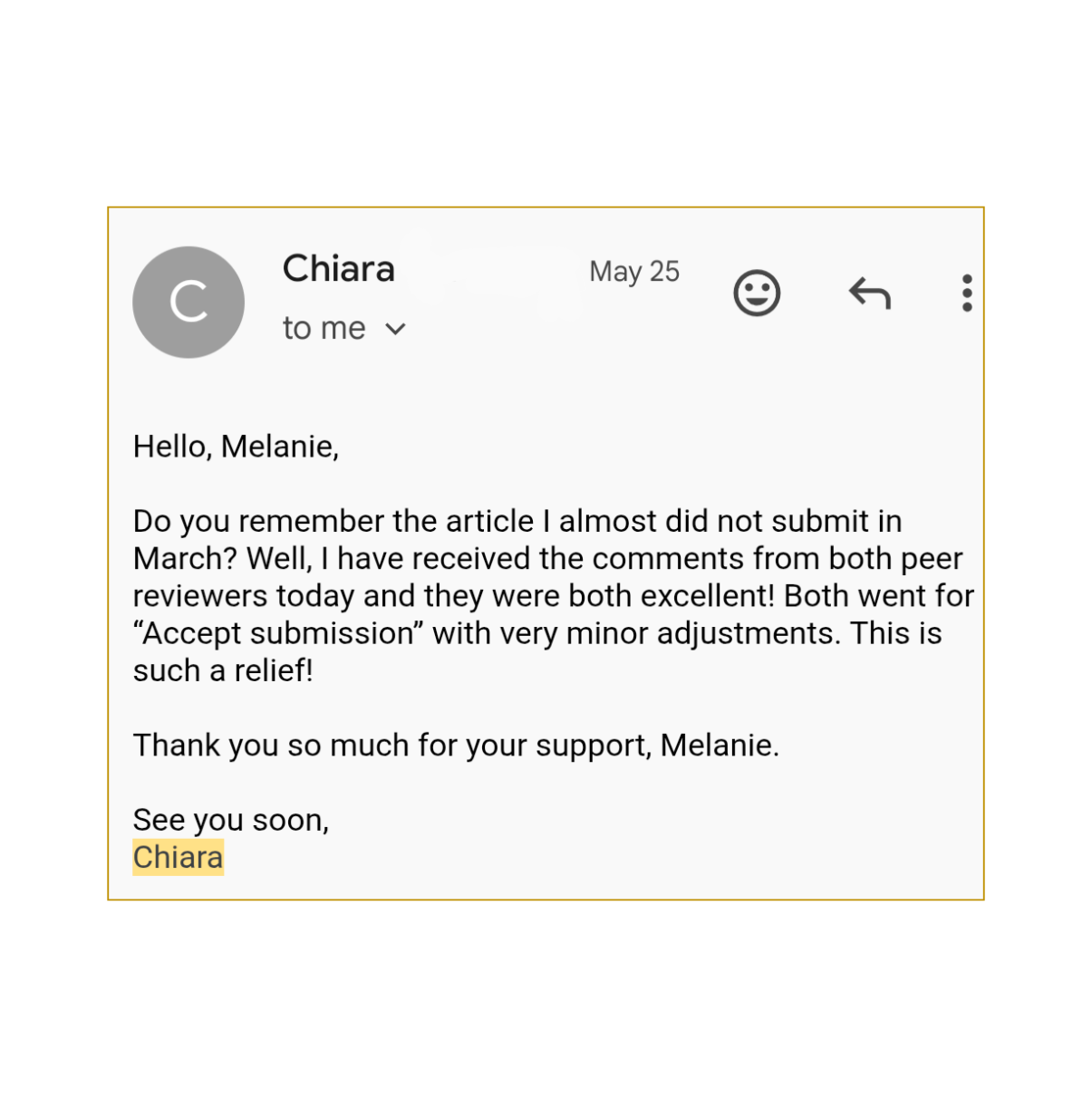
“Do you remember the article I almost did not submit in March? … both peer reviewers … went for ‘Accept submission’ with very minor adjustments.”
- Chiara
Katie: Two papers submitted — both accepted
Background
Katie was an academic at a UK Russell Group university.
Problem
She described beginning the work anxious about writing and prone to procrastination, with a writing practice that had become emotionally difficult and unsustainable.
During coaching
We put structure around the writing process so that she knew what she was doing at each stage, while working on a healthier and more sustainable relationship with academic writing rather than repeatedly fighting the same battle with the page.
Outcome
Katie submitted two journal articles during the period we worked together. Both were subsequently accepted. She also described a wider change in her relationship with writing that she expected to carry into the pressures of term time.
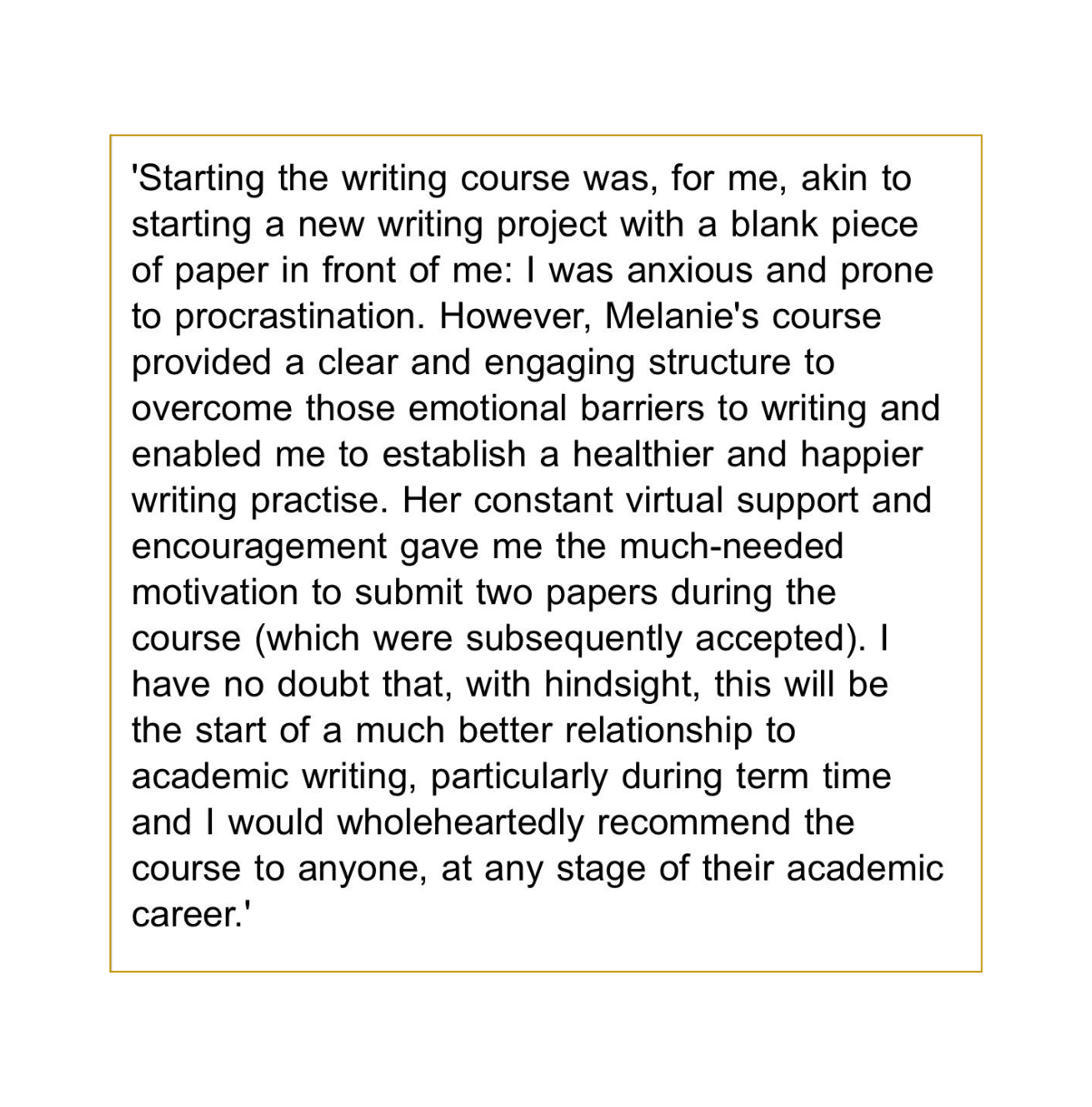
“Her constant virtual support and encouragement gave me the much-needed motivation to submit two papers during the course (which were subsequently accepted).”
-Katie
Anna: Navigating repeated revisions to acceptance
Background
Anna was working on a paper going through a demanding editorial process.
The problem
The paper required significant attention to its abstract, introduction and responses to editorial requests.
During coaching
You provided substantive feedback on the paper, particularly the abstract and introduction, and helped her work through the editors' requirements.
Outcome
After three rounds of conditional acceptance, the paper was accepted.
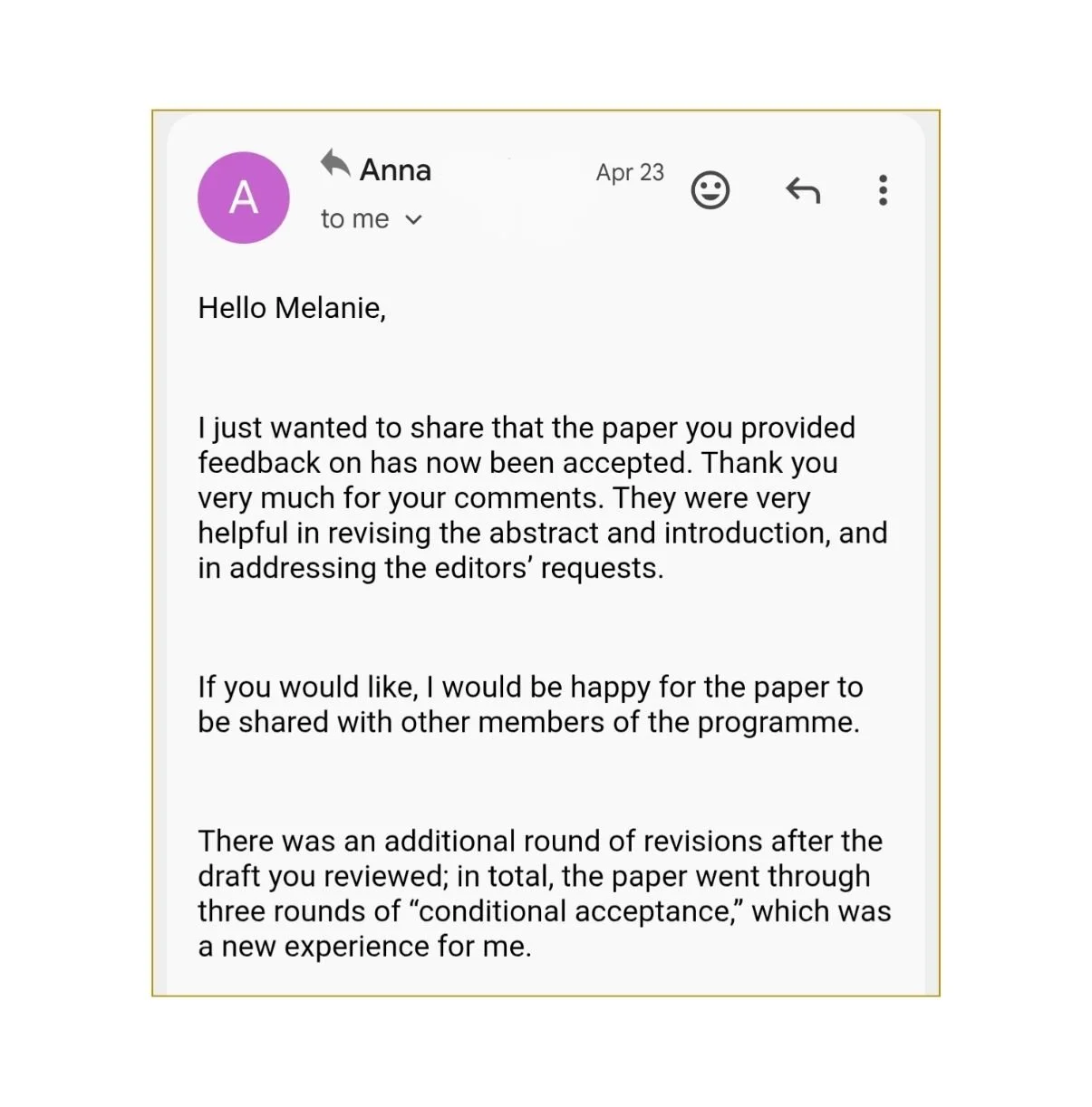
“The paper you provided feedback on has now been accepted. Thank you very much for your comments. They were very helpful in revising the abstract and introduction…”
-Anna
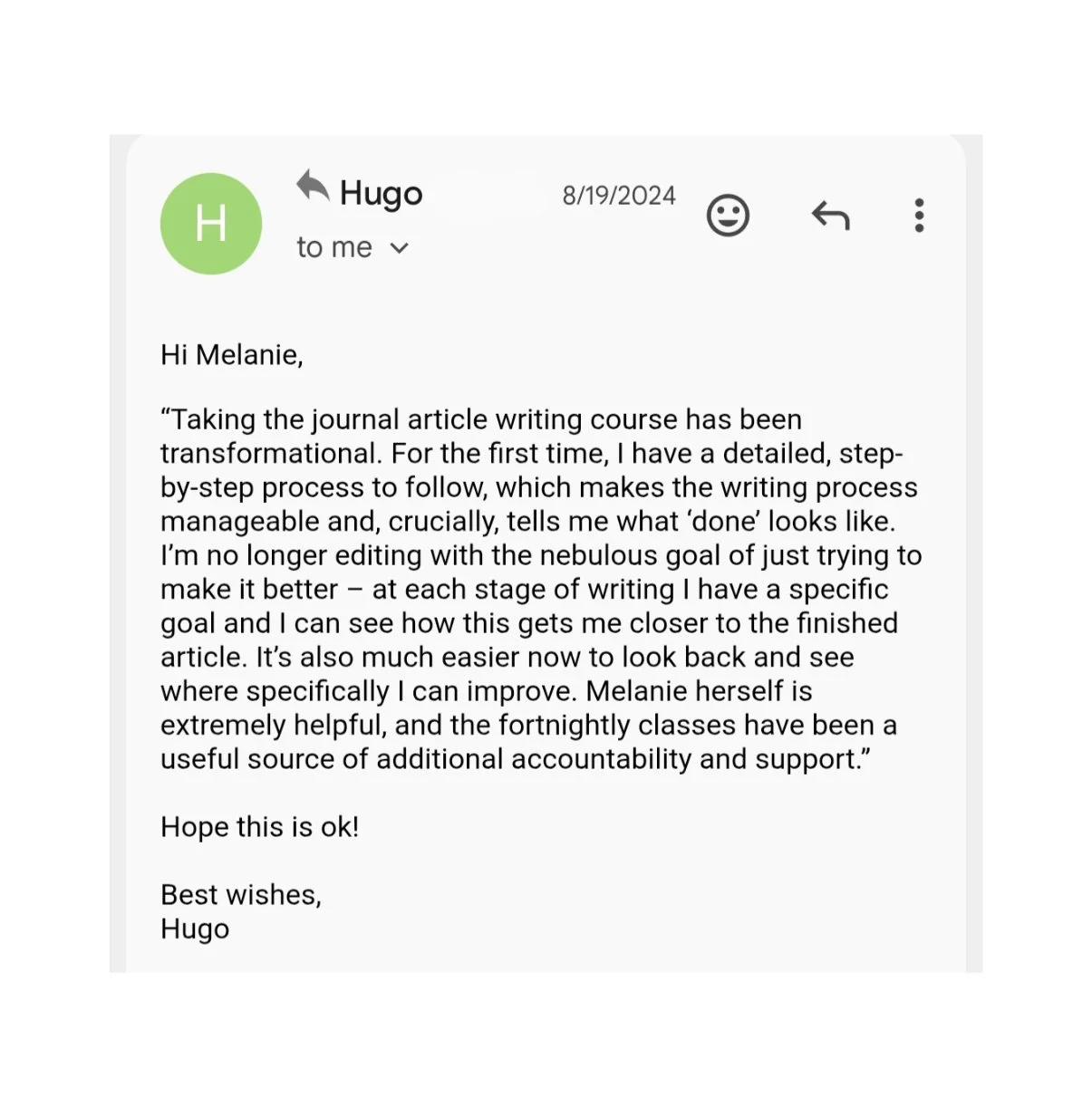
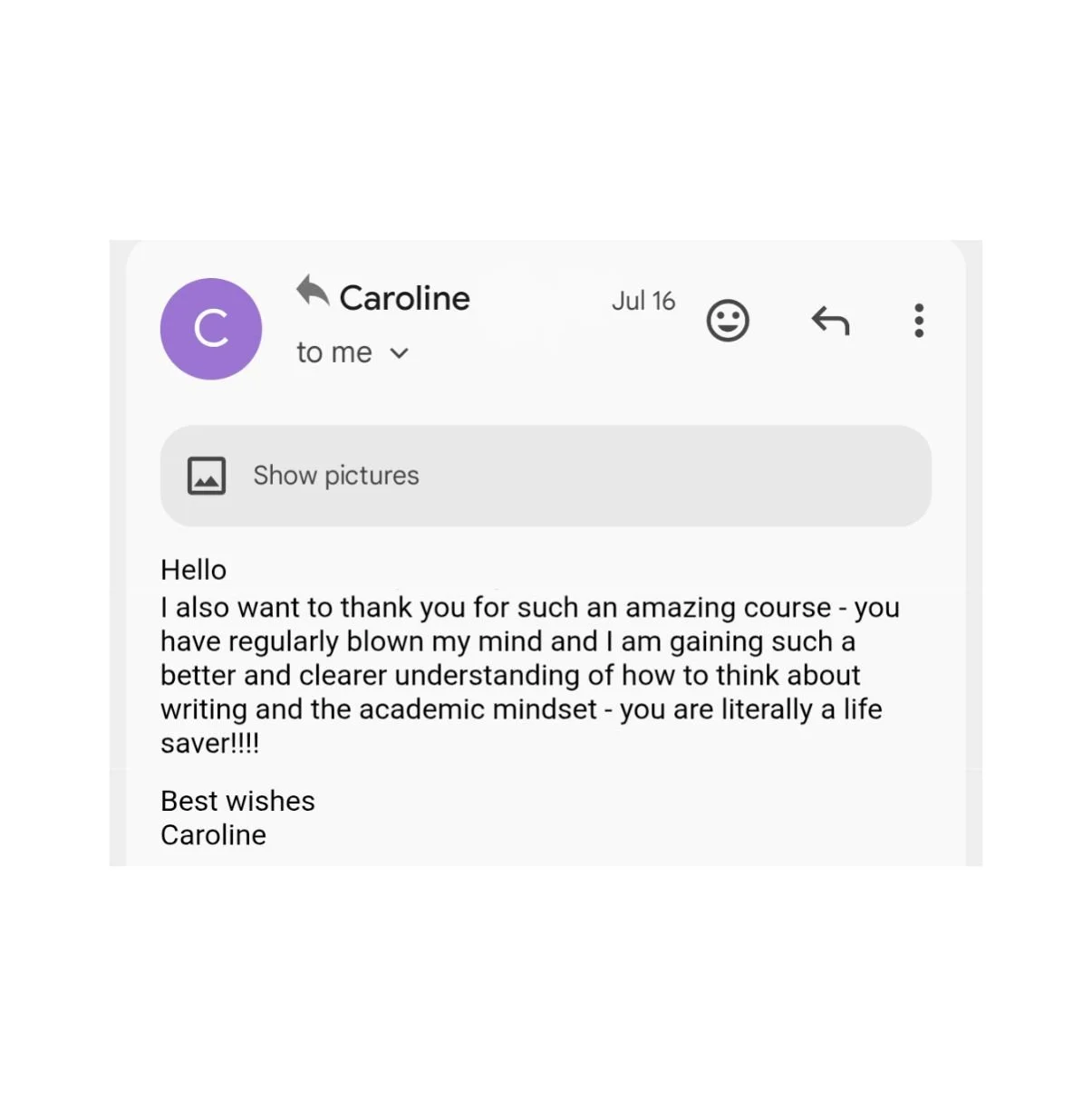
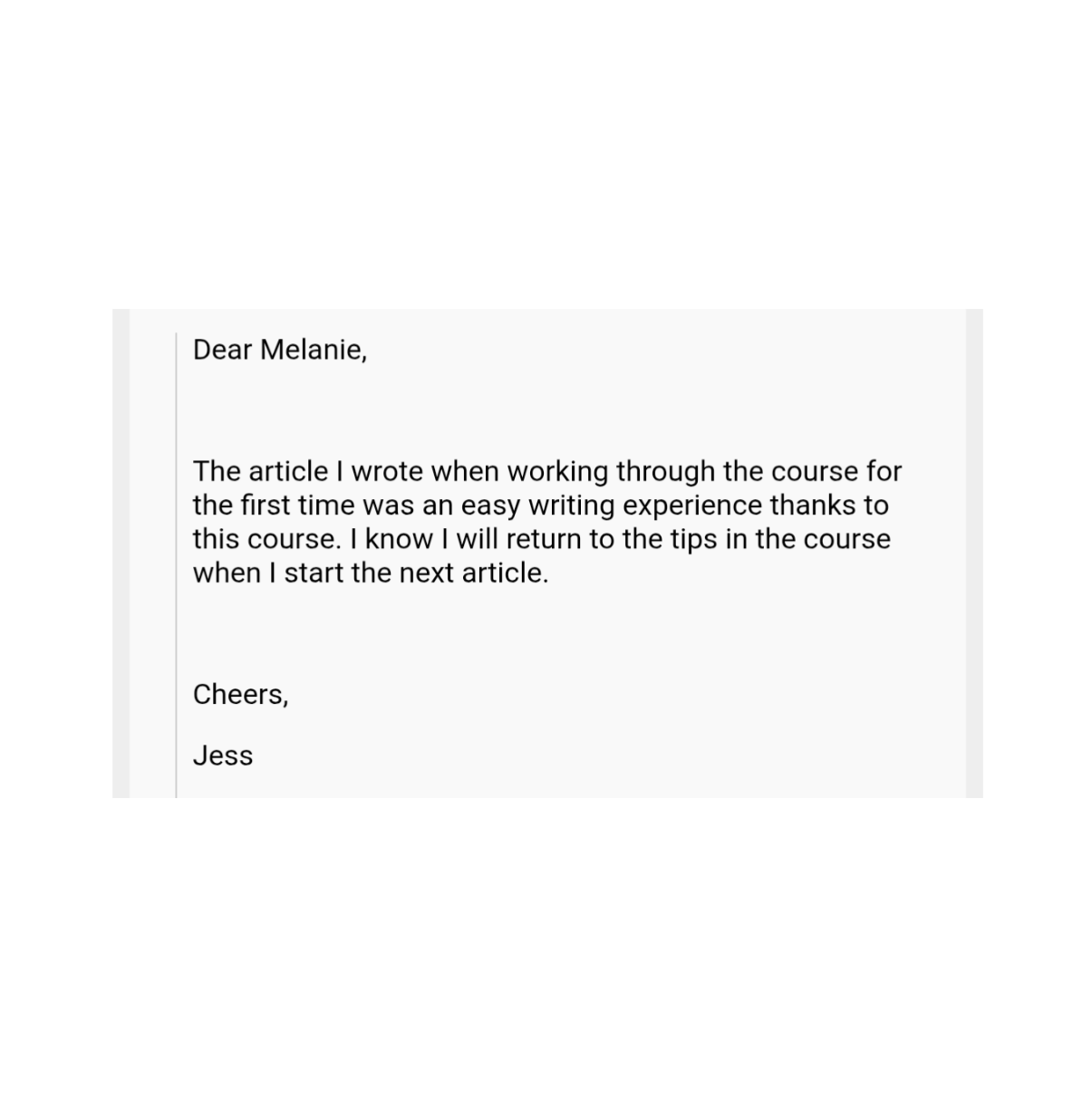
See more publication results
For those who want help with Monographs & Second Books
Anonymous: Finally finishing the monograph
Background
An academic who had spent years starting, investing in and then abandoning work on her monograph.
Problem
Writing the book had become bound up with unproductive habits and what she called her 'writing demons'. She repeatedly became stuck and dropped the project.
During coaching
We worked on practical writing methods, a sustainable routine and the actual drafts of the book, with a structure that kept the project moving rather than allowing it to disappear whenever academic life became demanding.
Outcome
For the first time in years, she felt able to say confidently that she was finishing the monograph — and that the process actually felt good.
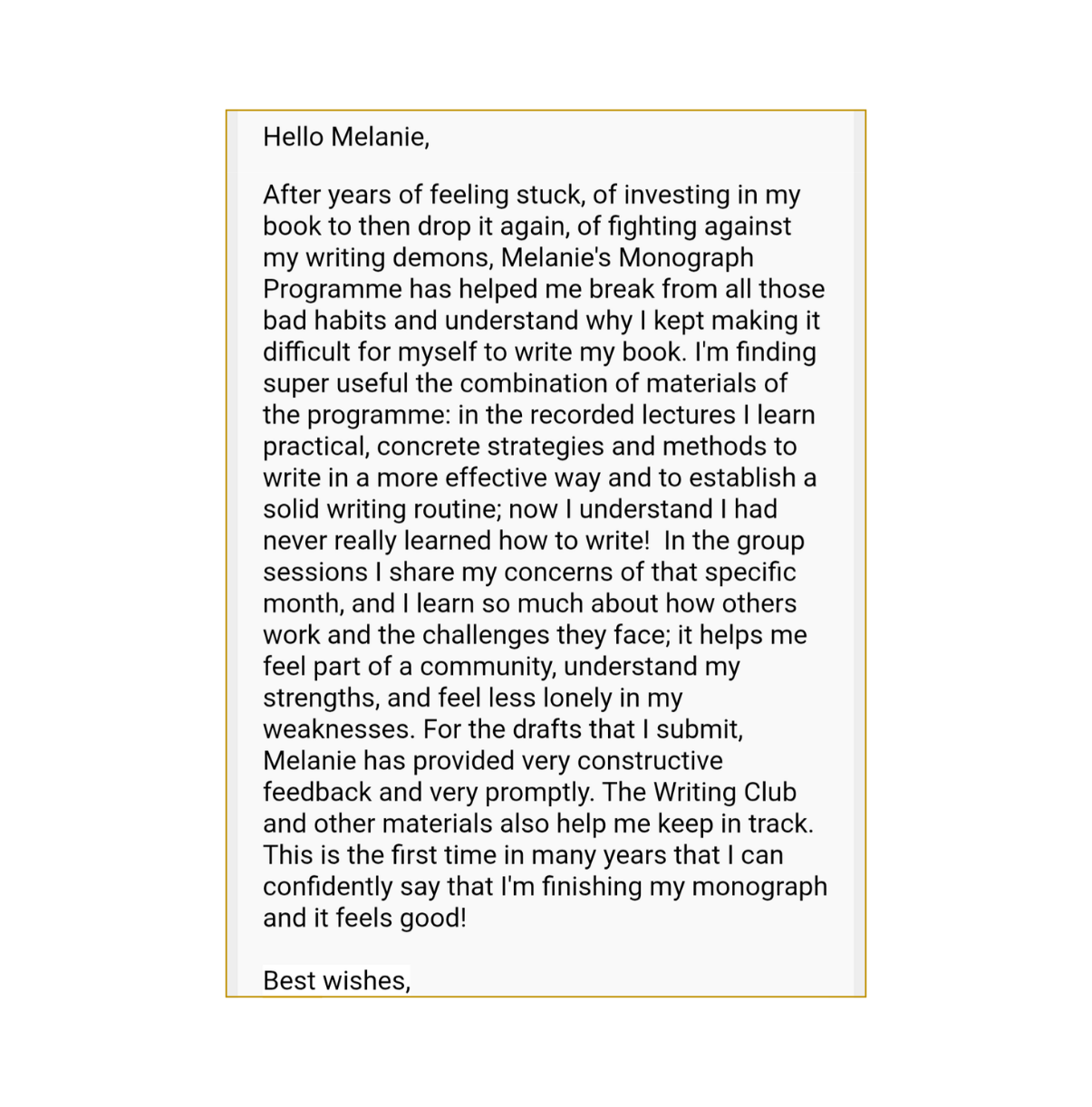
“This is the first time in many years that I can confidently say that I'm finishing my monograph and it feels good!”
-Anonymous
Hannah: The book proposal that had been waiting for two years
Background
Hannah was an academic with a book project she wanted to move forward. Her book proposal had been 'in the making' for more than two years.
Problem
The problem was not a lack of intellectual material. Serious writing was repeatedly being displaced by the competing expectations of academic work, and the proposal remained unfinished.
During coaching
During the live Writing Accelerator, we worked on putting writing back at the centre of her academic practice and building practical systems for protecting and progressing it.
Outcome
Within a month of completing the Accelerator, Hannah wrote the book proposal. She described doing it 'with ease' after more than two years of it remaining unfinished. She is now writing the book.
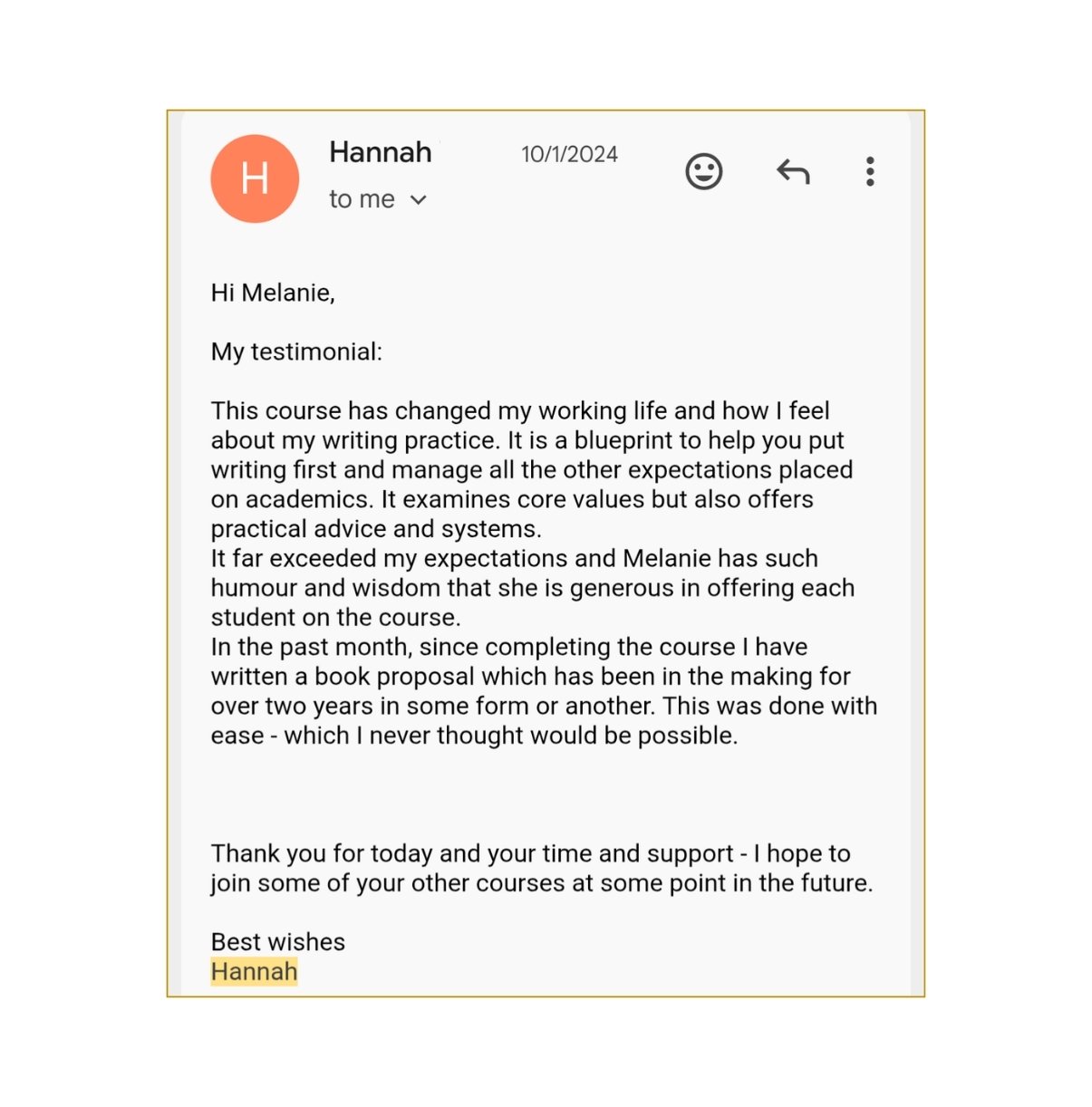
“In the past month, since completing the course I have written a book proposal which has been in the making for over two year — with ease.”
-Hannah
Kyle: A better first book, on track for deadline
Background
Kyle was writing his first book.
Problem
The project felt lonely, daunting and overwhelming. He needed a way to manage a large, intellectually complex project without losing sight of the book as a whole.
During coaching
We combined a systematic, evidence-based writing process with individual guidance, planning and problem-solving as the manuscript developed.
Outcome
At the point of his testimonial, Kyle was on track to meet his publishing deadline. He believed the book itself was substantially better and was enjoying the writing process far more.
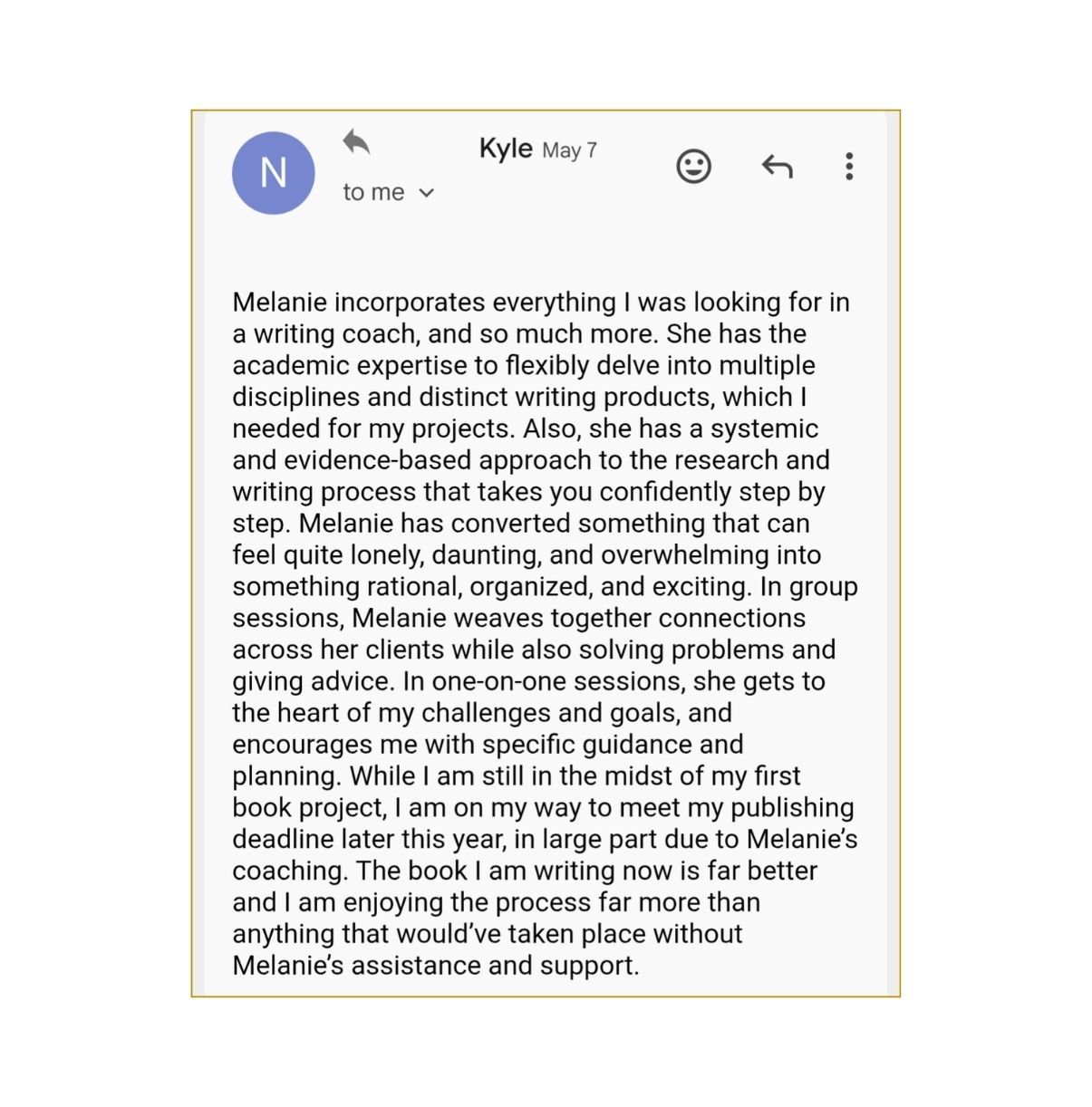
“The book I am writing now is far better and I am enjoying the process far more than anything that would've taken place without Melanie's assistance and support.”
-Kyle
For Universities who are looking to for help…
From two workshops to an internal university referral
Dublin City University Institute of Education | Bespoke Academic Development
Background
Dr Sinéad McNally approached me to provide bespoke academic development for colleagues at DCU's Institute of Education. The challenge was to create training that would be genuinely useful to academics with different levels of experience and different research and writing needs.
What we worked on
I worked with Sinéad to develop and deliver two tailored workshops for her colleagues, focused on practical strategies academics could apply directly to their own writing and research practice.
The response extended beyond the workshops themselves. Sinéad reported that colleagues were continuing to talk about and use the strategies afterwards.
What changed
Following the two workshops, Sinéad recommended my work to colleagues elsewhere in the university. That recommendation led to a further commission from another department, working with Marie and her colleagues.
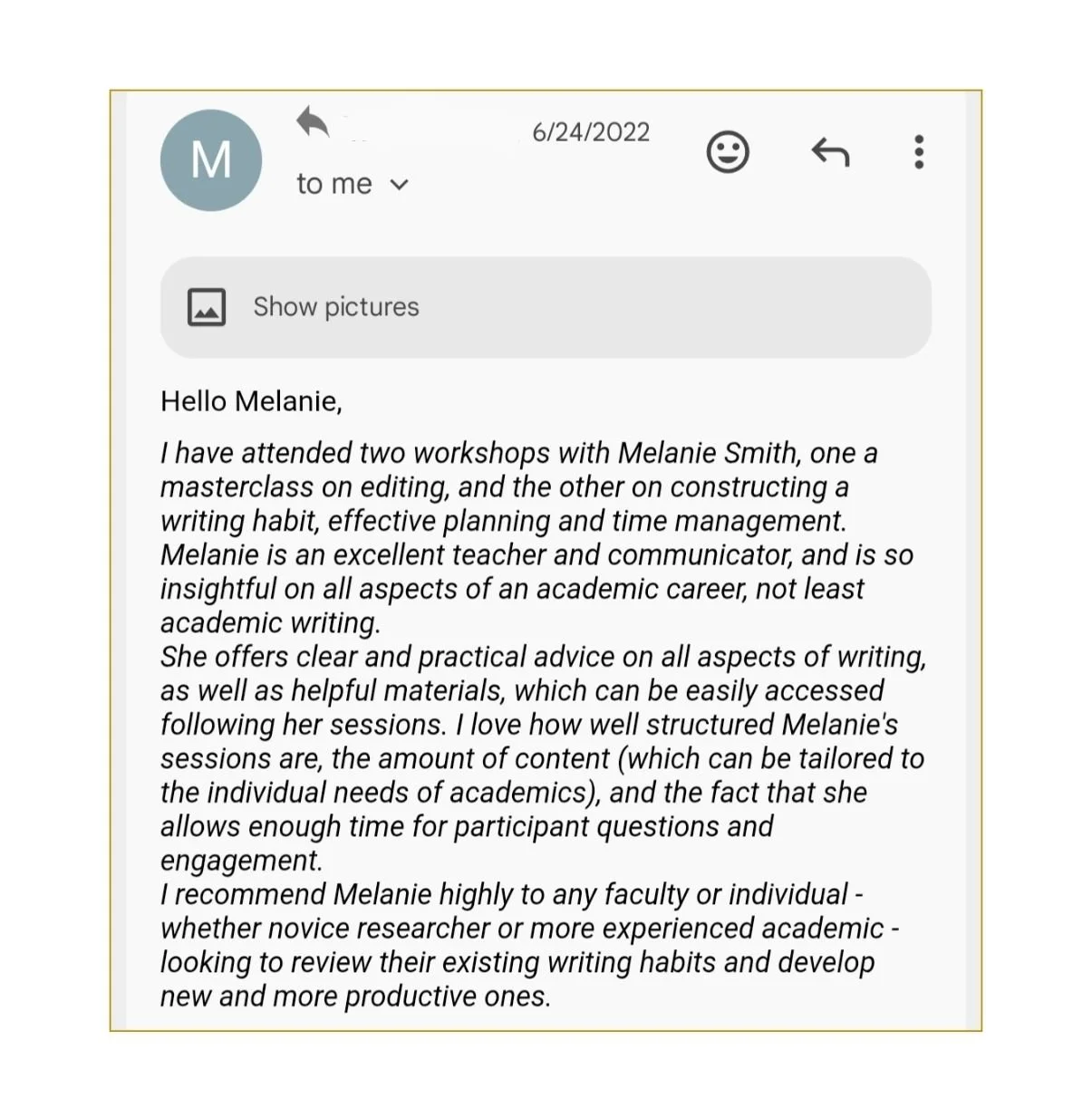
“She offers clear and practical advice on all aspects of writing as well as helpful m,a…”
- Anonymous
For those who want help with completing a PhD
Fatima: From struggling to write in English to completing the thesis
Background
Fatima was completing a PhD as a non-native English speaker.
Problem
At the beginning of her doctorate she found it extremely difficult to structure complex arguments in English. The difficulty was serious enough that giving up became a real possibility.
During coaching
We worked on the underlying craft of academic writing and argumentation: how to structure complex ideas, organise the argument and make the writing carry the intellectual work she was capable of doing.
Outcome
Fatima successfully submitted the thesis and obtained her PhD. Her supervisors were highly complimentary about the writing in the final version, and she credited the coaching in her thesis acknowledgements.
Strong line
“By the time my supervisors read the final versions of my thesis, they were very complimentary of my writing.”
Screenshot
Use Fatima's original testimonial screenshot (Fatima Maria Pillosu.jpg), cropped to first name only. If possible, retain the submission news and the passage about her supervisors' response.
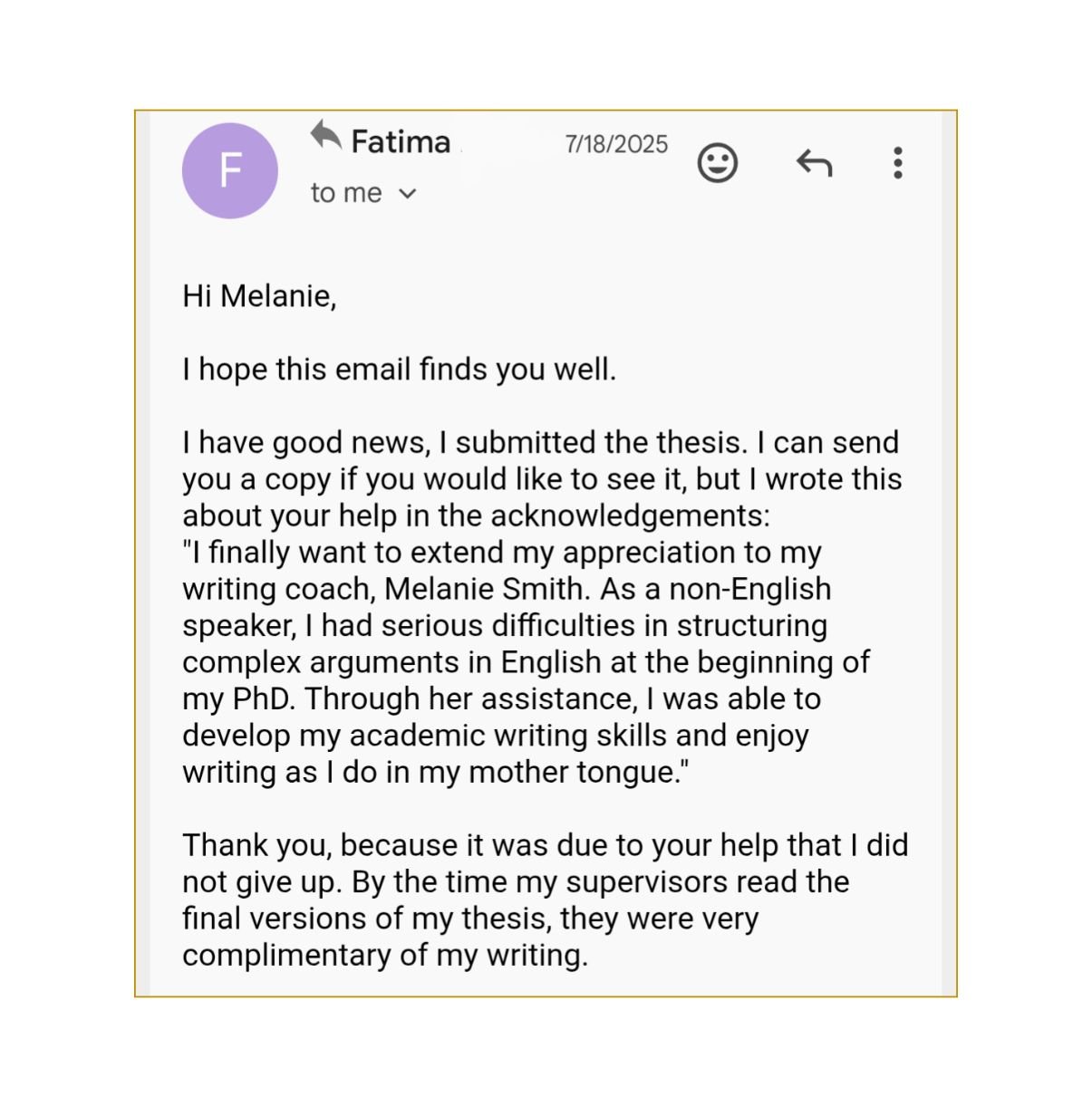
“By the time my supervisors read the final versions of my thesis, they were very complimentary of my writing.”
- Fatima
Anonymous: From stuck and unsupported to a completed PhD
Background
A Geography PhD researcher at a UK Russell Group university had experienced multiple changes of supervisor.
Problem
The disruption left her without consistent writing support. She was struggling to organise her thoughts and structure the thesis, which fed procrastination and a sense of being stuck because she could not see clearly how the pieces of the doctorate fitted together.
During coaching
We worked on the intellectual architecture of the thesis: refining the positioning of chapters, restructuring an unfocused and unwieldy literature review, establishing the hierarchy between themes, making connections across disciplines, and explaining the overall contribution and arguments more succinctly.
Outcome
She successfully submitted the thesis and completed her PhD. She is now Dr. The important change was greater control over the thesis and greater confidence in making the scholarly decisions required to finish it.
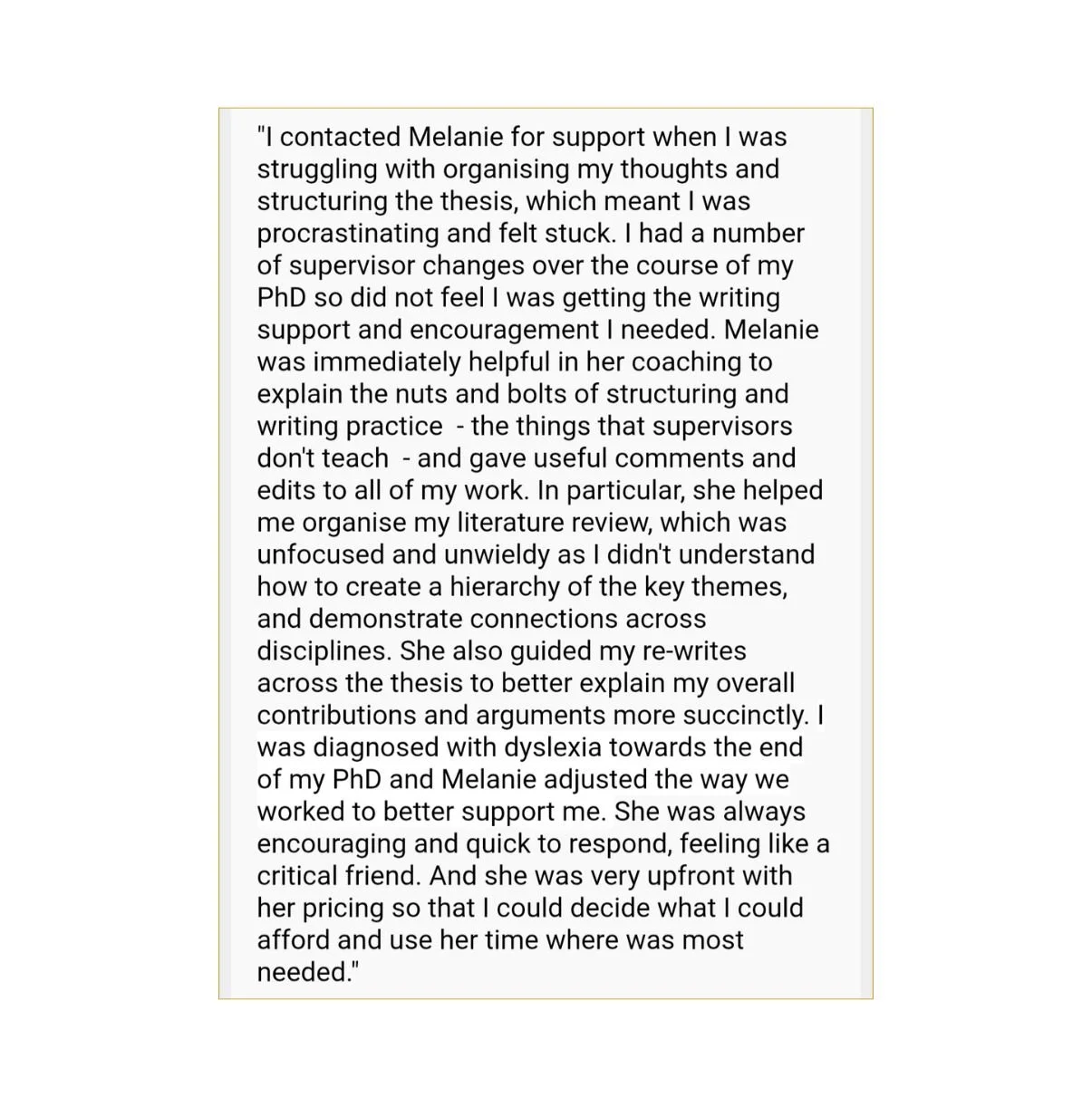
"She helped me organise my literature review... and demonstrate connections across disciplines"
-Anonymous
Matt: Long-term support through thesis and viva
Background
Matt worked with me across five to six years of his PhD.
Problem
His needs changed as the doctorate developed. At different points he needed help understanding what his supervisor wanted, navigating difficult literature and concepts, articulating complex ideas, strengthening the thesis and developing confidence in his academic writing.
During coaching
The work combined writing craft, interpretation of supervisory expectations and a critical sounding board through which Matt could develop and test his ideas rather than simply receive corrections to drafts.
Outcome
Matt describes the support as a 'game-changer' for his PhD. By the time he was approaching the viva, he reported substantially greater confidence both in the thesis and in articulating the work verbally.
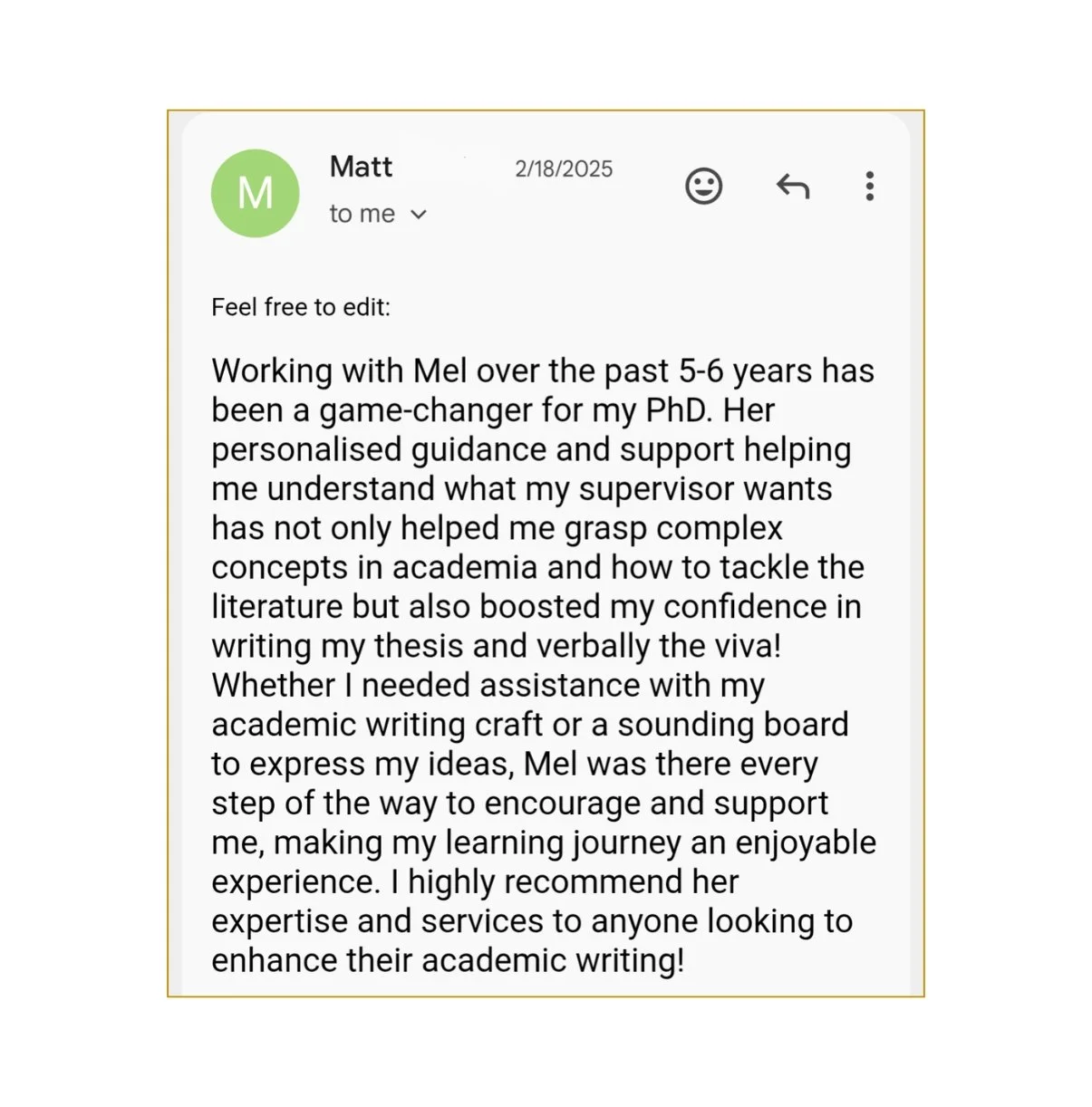
“Working with Melanie throughout my PhD has been a game-changer.”
- Matt
For those who want to excel in their Academic Careers
Daniel: From PhD student to a growing academic career
Background
Daniel first came to work with me as a PhD student. He later returned as a junior academic and is now working with me at a more strategic career level.
Problem
At each stage, the problem changed. During the PhD he needed to move from thinking and writing like a student to operating as an independent scholar. As a junior academic, he needed to turn research into a serious publication record. The next challenge was to decide what those outputs were building towards.
During coaching
During the PhD we worked on scholarly independence and writing. When Daniel returned as a junior academic, we worked directly on three journal articles through the writing and publication process; all three were subsequently published. The work then widened into publication pipeline, career strategy and longer-term intellectual profile.
Outcome
Daniel completed the PhD. Within the first three months of the more strategic career work, he secured a promotion. In 2026 he has five published papers and three more under review, and he is developing a book proposal for Cambridge University Press.
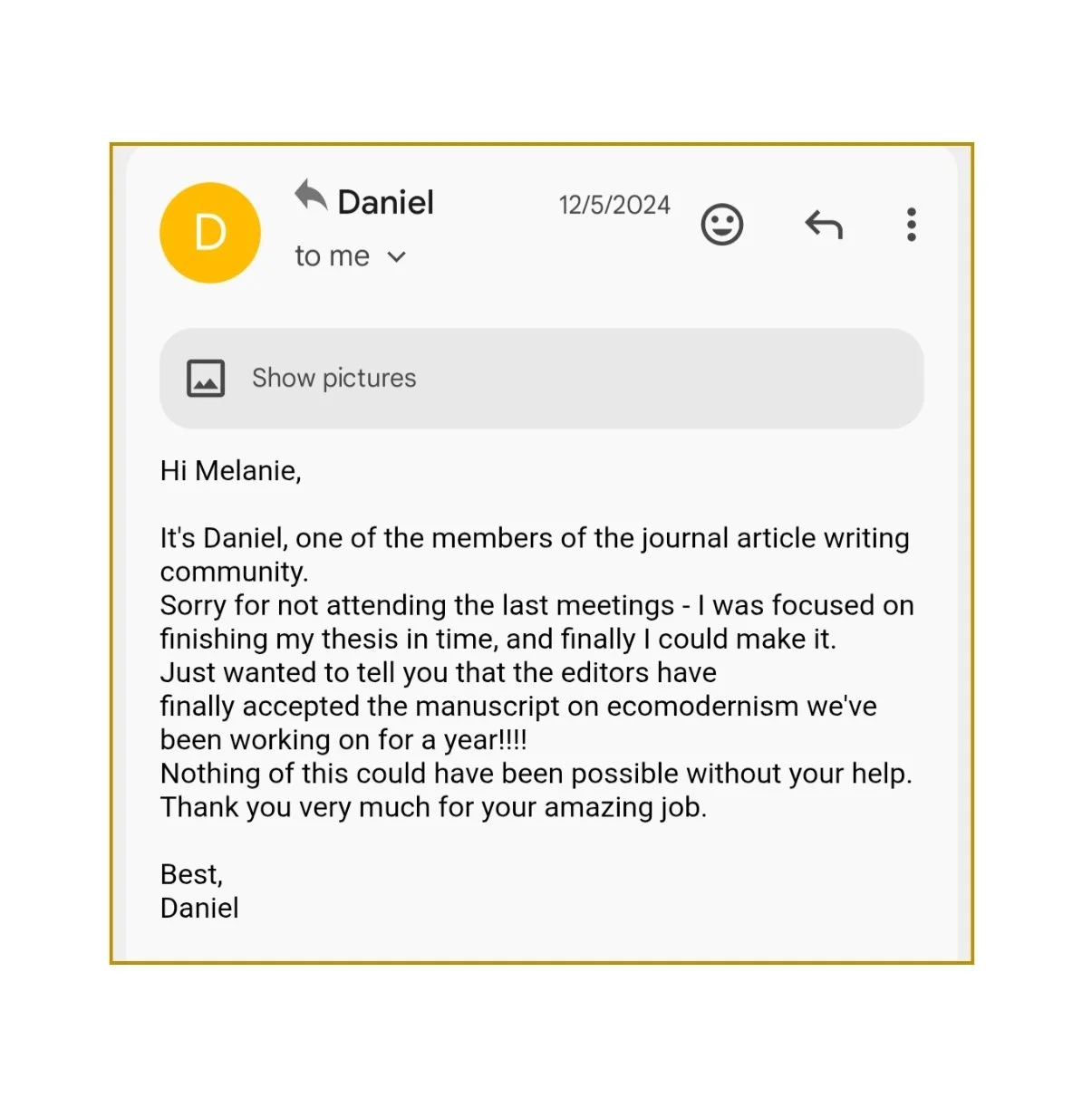
“Nothing of this could have been possible without your help.”
-DF
Saskia: Returning to the scholarly stage after years away
Background
Saskia was an academic researcher who wanted to rebuild an effective writing practice and re-enter visible scholarly life.
Problem
The issue was larger than one unfinished paper. Old habits were making academic writing inefficient, and she had also been absent from the conference stage for many years.
During coaching
In less than two months, Saskia describes changing old habits into more efficient academic writing skills. I reviewed her paper closely as it developed, while we also worked on the routines and decisions surrounding the writing and encouraged her to step back into academic visibility.
Outcome
The paper was published. Saskia then attended her first conference after many years away and was elected best presenter. The result was both scholarly output and renewed visibility as the scholar producing it.
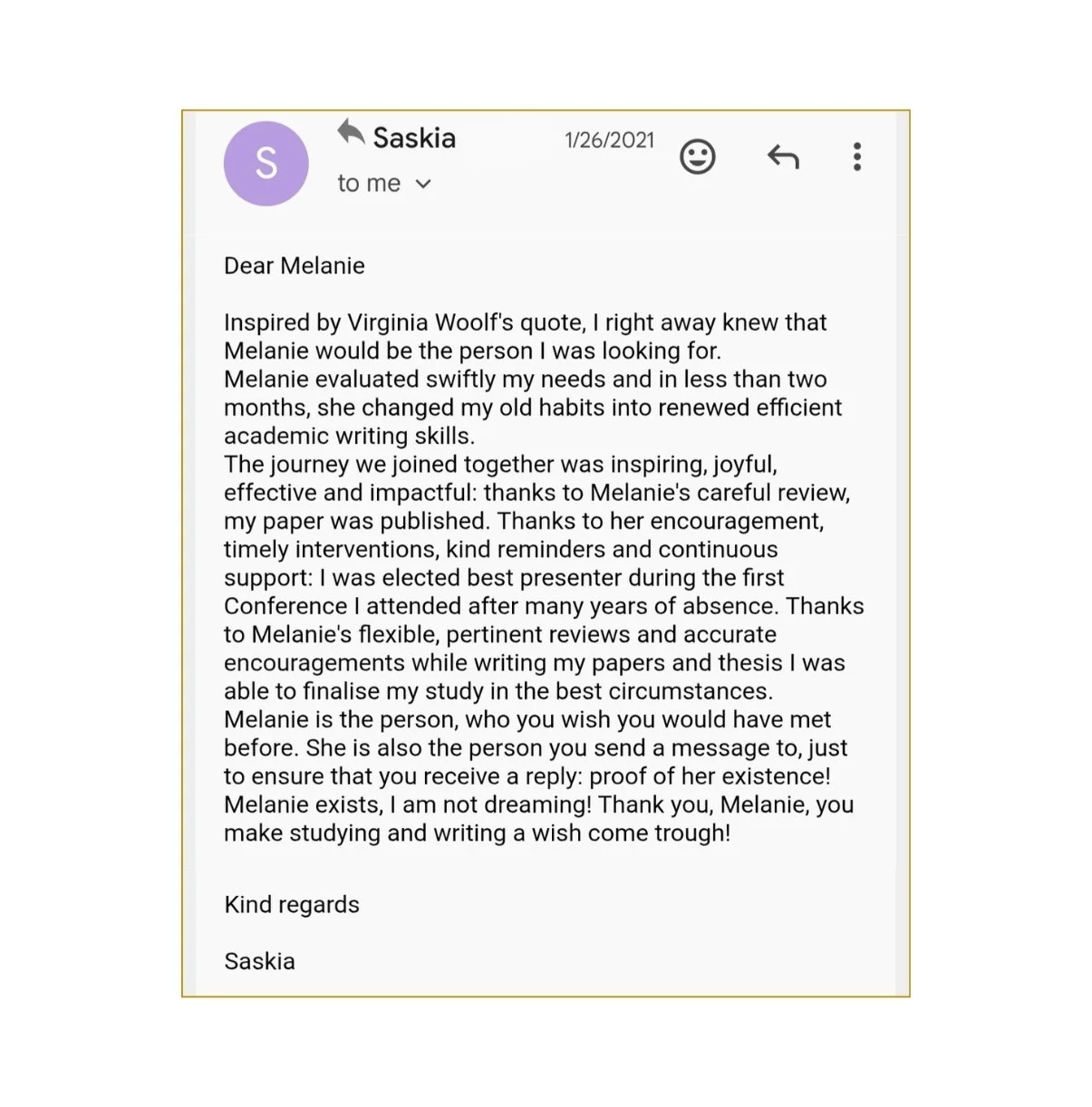
“In less than two months I changed my old habits into efficient academic writing skills… My paper was published… I attended my first conference after many years of absence and was elected best presenter.”
- Saskia
Emma: Reclaiming an academic identity that had almost disappeared
Background
Emma was an academic whose own research had progressively been pushed to the margins by the demands surrounding it.
Problem
She described arriving 'lost, despondent' and as though she was mourning the loss of her academic life. Bureaucratic demands, caring responsibilities and other pressures had made it increasingly difficult to maintain an active research identity.
During coaching
The work was not about telling Emma to work harder. We rebuilt an academic practice that could survive inside the life and job she actually had, using processes and tools that allowed her to protect and progress her own research.
Outcome
A few months later, Emma described herself as having reclaimed her identity as an active academic, with a sustainable, productive and enjoyable research practice — and a renewed sense that she had a future as an active researcher.
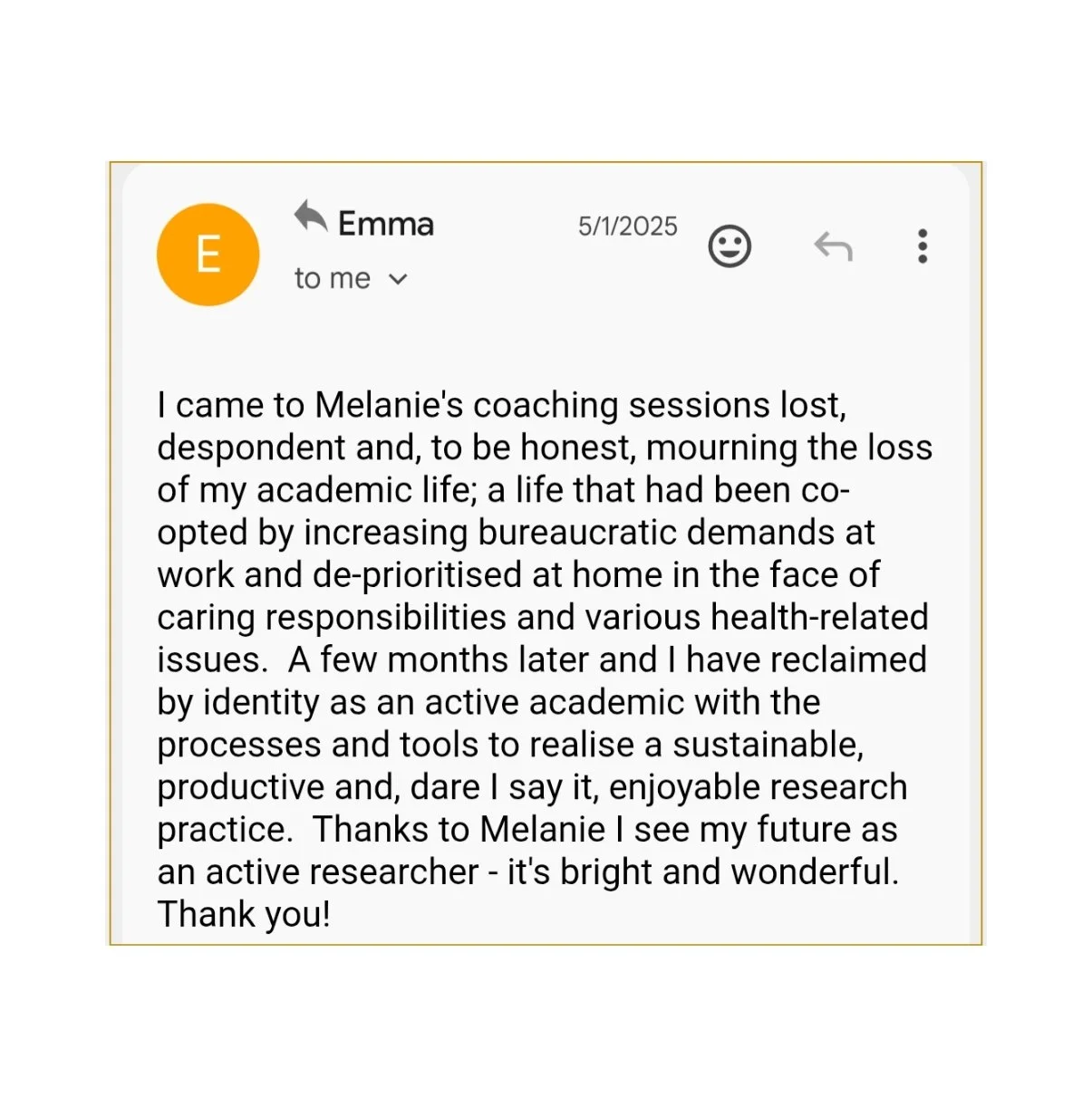
“I have reclaimed my identity as an active academic.”
- Emma
For Universities & Research Teams looking to improve outcomes
University of Westminster: From two workshops to a multi-year research development partnership
Background
My work with Westminster began in 2024 with two workshops: one on academic writing and one on building and executing a research publication pipeline.
Problem
The School wanted more than generic training. Colleagues at different career stages needed practical support with finishing projects, publication strategy, manuscript submission, research quality and the systems required to sustain research alongside academic workloads.
During coaching
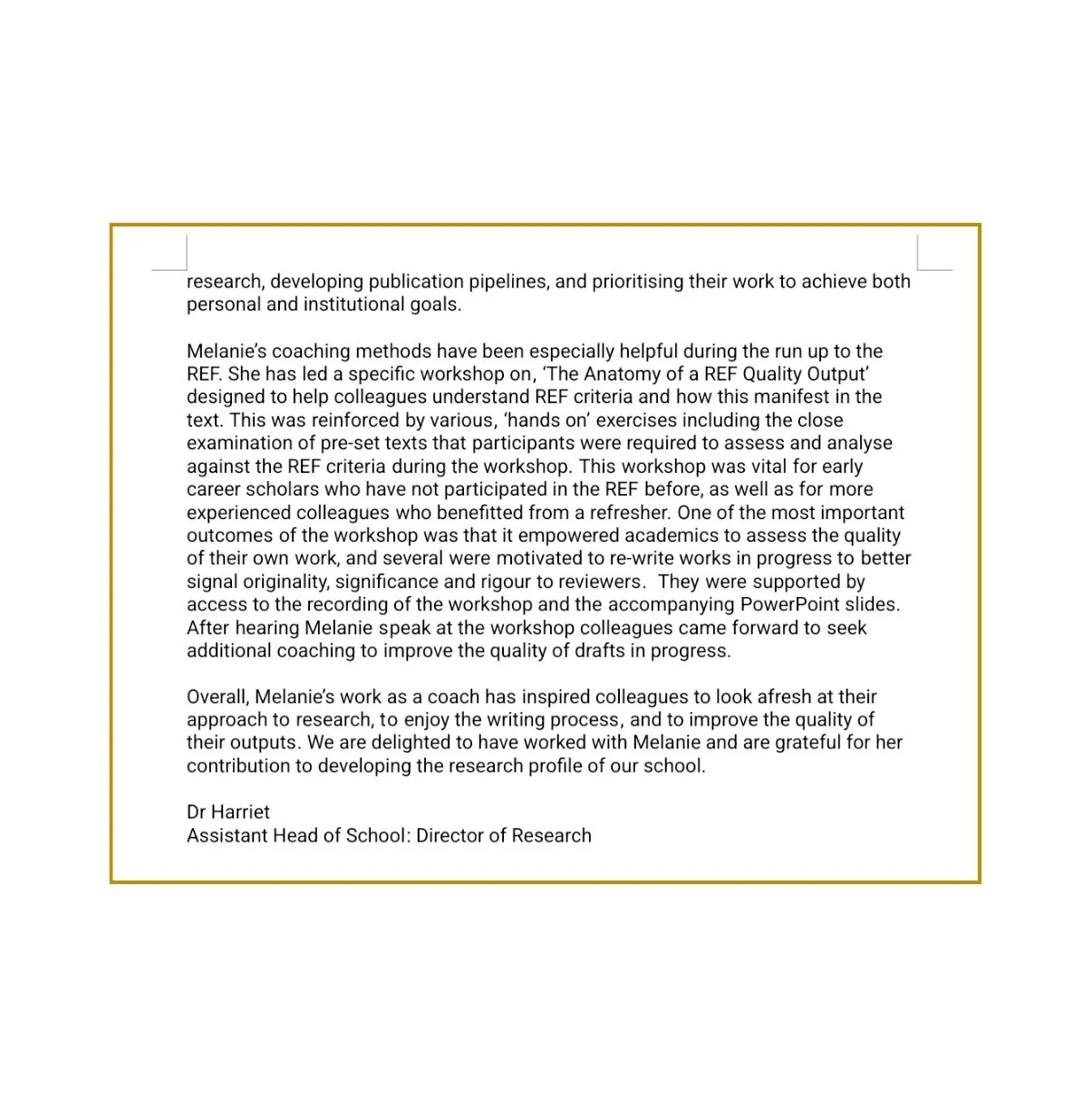
Following the workshops, the School expanded the work and I went on to coach more than twelve academics. The partnership then extended into REF development, including close analysis of how originality, significance and rigour manifest in the text of an output and how academics can assess and improve work in progress.
Outcome
Harriet, the School's Director of Research, reported significant changes in time management, organisation, productivity and the quality of outputs. Colleagues became more strategic about pipelines and journal targeting; several chose to rewrite work in progress after the REF workshop; and Harriet concluded that the work had contributed to developing the School's research profile.
Strong line
“There is a clear before and after once you introduce Melanie's processes into your writing practice.”
Screenshot
Use Harriet's formal institutional testimonial as the main evidence source. If her name appears in a caption, use 'Harriet' only. The university name may remain visible. A second useful line is her assessment that the work contributed to the School's research profile.
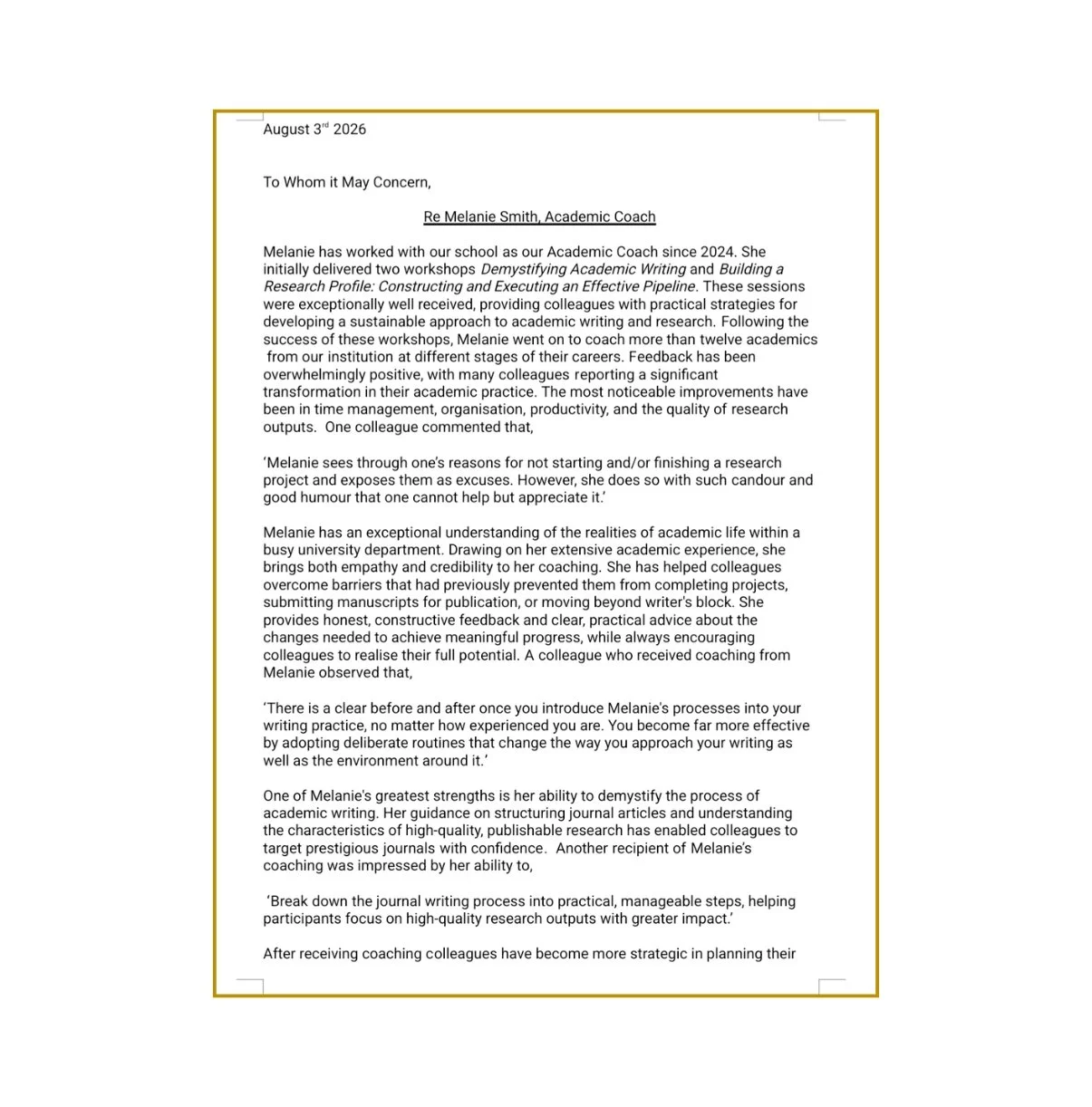
“There is a clear before and after once you introduce Melanie's processes into your writing practice.”
-Dr. Harriet
University of Melbourne: Designing writing training around what PhD researchers actually needed
Background
The University of Melbourne approached me about writing training for a cohort of PhD researchers in Microbiology and Immunology in a joint doctoral programme.
Problem
Rather than begin with a generic request for 'academic writing training', the programme coordinator surveyed the cohort to identify where researchers were actually struggling. Three issues came through particularly strongly: writing Introductions, writing Discussions and developing the critical analysis expected at doctoral level.
During coaching
Working with Annabelle, I designed two bespoke masterclasses around those needs. The first focused on drafting and developing academic writing from scratch, incorporating the critical-thinking problems the researchers had identified. The second focused on editing and gave participants a systematic process for diagnosing and improving their own drafts. The live training was supplemented with additional coaching videos and resources.
Outcome
Annabelle had previously attended a range of academic writing courses. She said these masterclasses stood out for their clarity and systematic, easy-to-apply approach. Participant feedback was also very positive, and she said she would recommend the training to other coordinators.
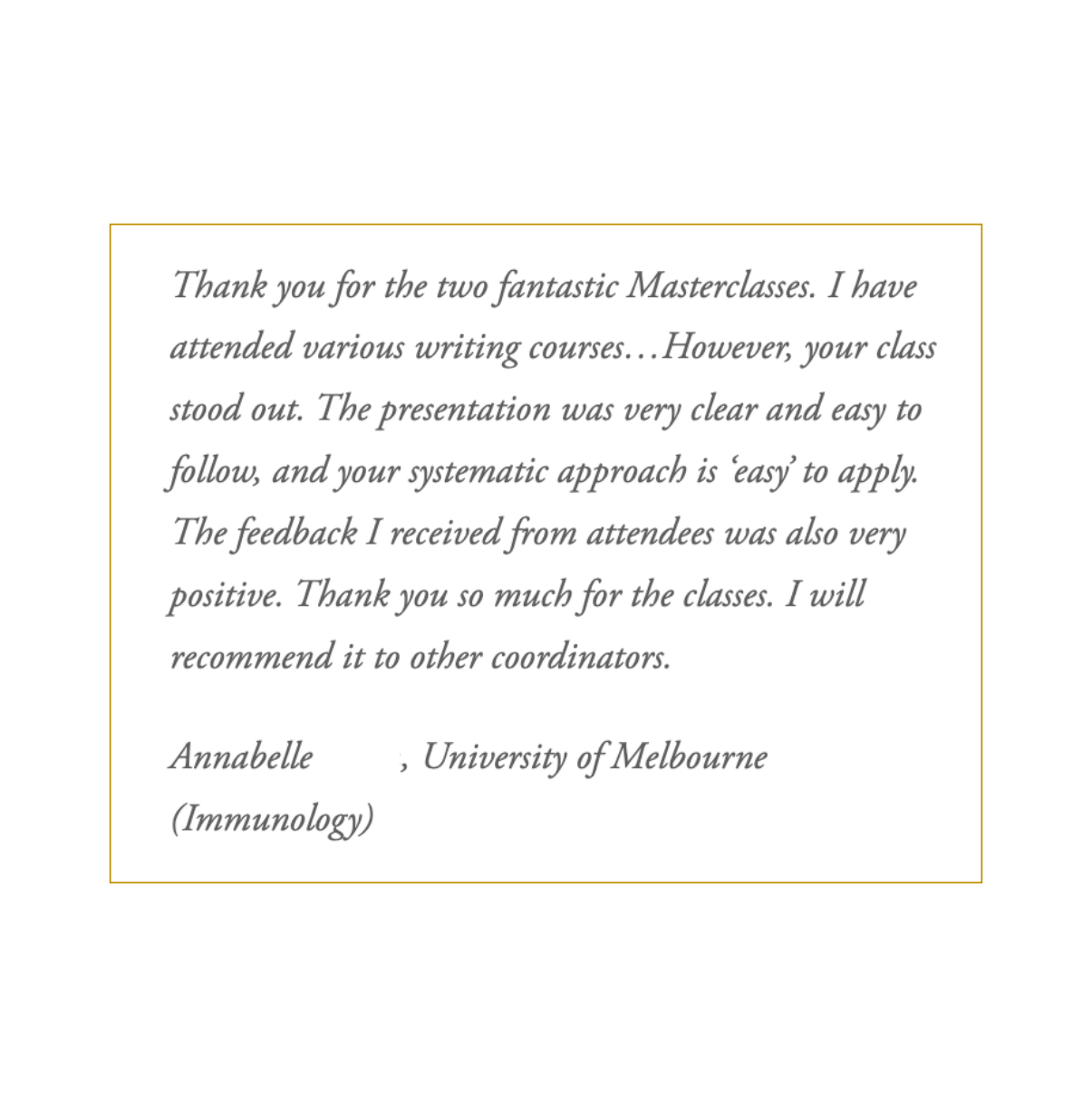
“I have attended various writing courses… However, your class stood out. The presentation was very clear and easy to follow, and your systematic approach is 'easy' to apply.”
- Annabelle
MORE PUBLICATION SUCCESSES
PUBLISHING JOURNAL ARTICLES
See more publication results
-
“My journal article was accepted and will be published in the Journal of Management Consulting this month.”
-
“An excellent set of guidelines that take you step by step how to best prepare for and write a journal article. If only I’d come across this material years ago!”
-
“10 days ago, the article you were supporting me was accepted… I am very firmly back on the writing ‘horse’.”
-
“She helped me move from feeling stuck with my writing (while deadlines loomed) to having a clear, repeatable process I can trust — and plan around.”
-
“I’ve just re-submitted the article! … Your support is invaluable!”
MONOGRAPHS & SECOND BOOKS
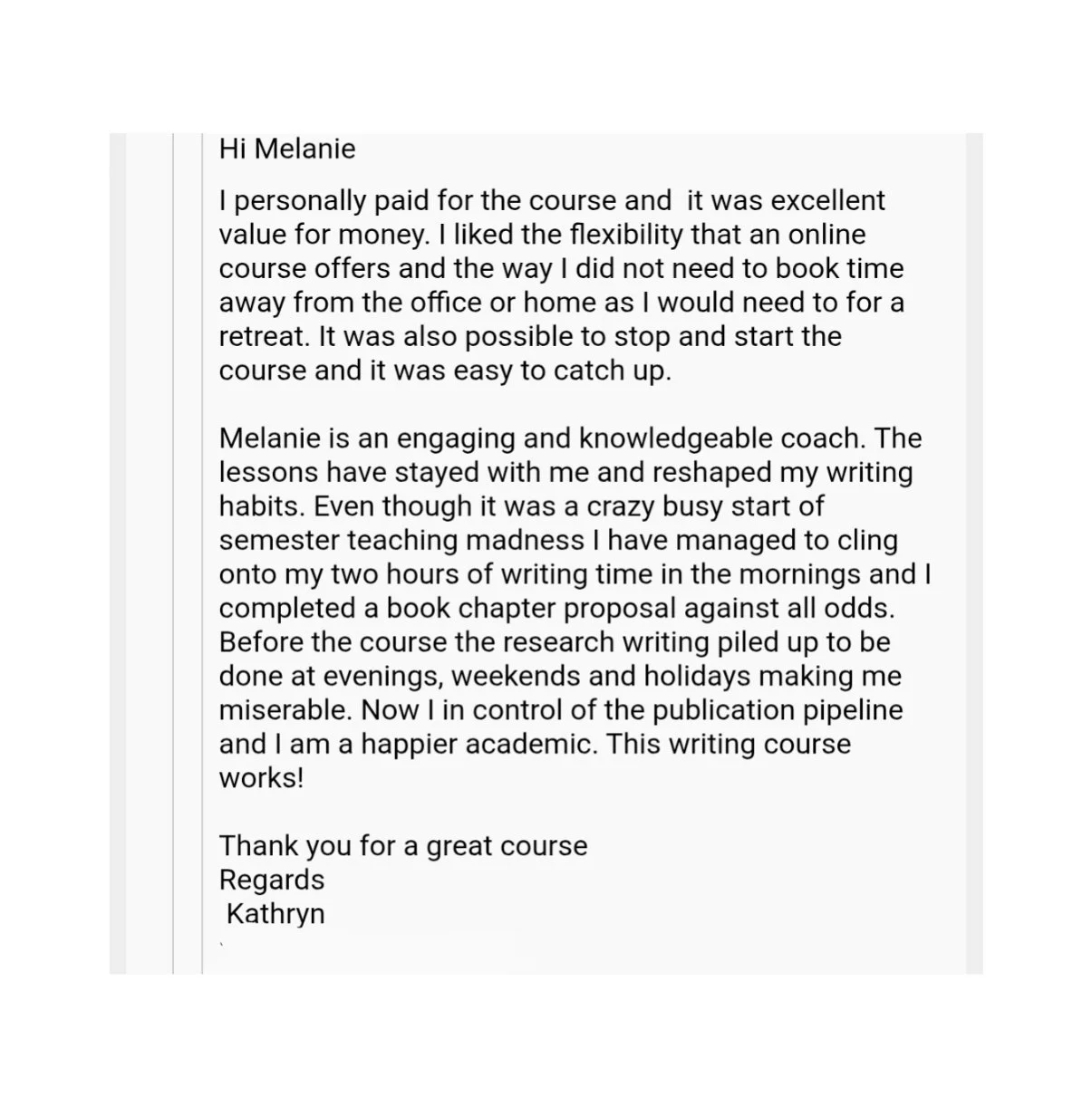
“Even though it was a crazy busy start of semester teaching madness I have managed to cling onto my two hours of writing time in the mornings and I completed a book chapter proposal against all odds”
- Dr. Kathryn Waite
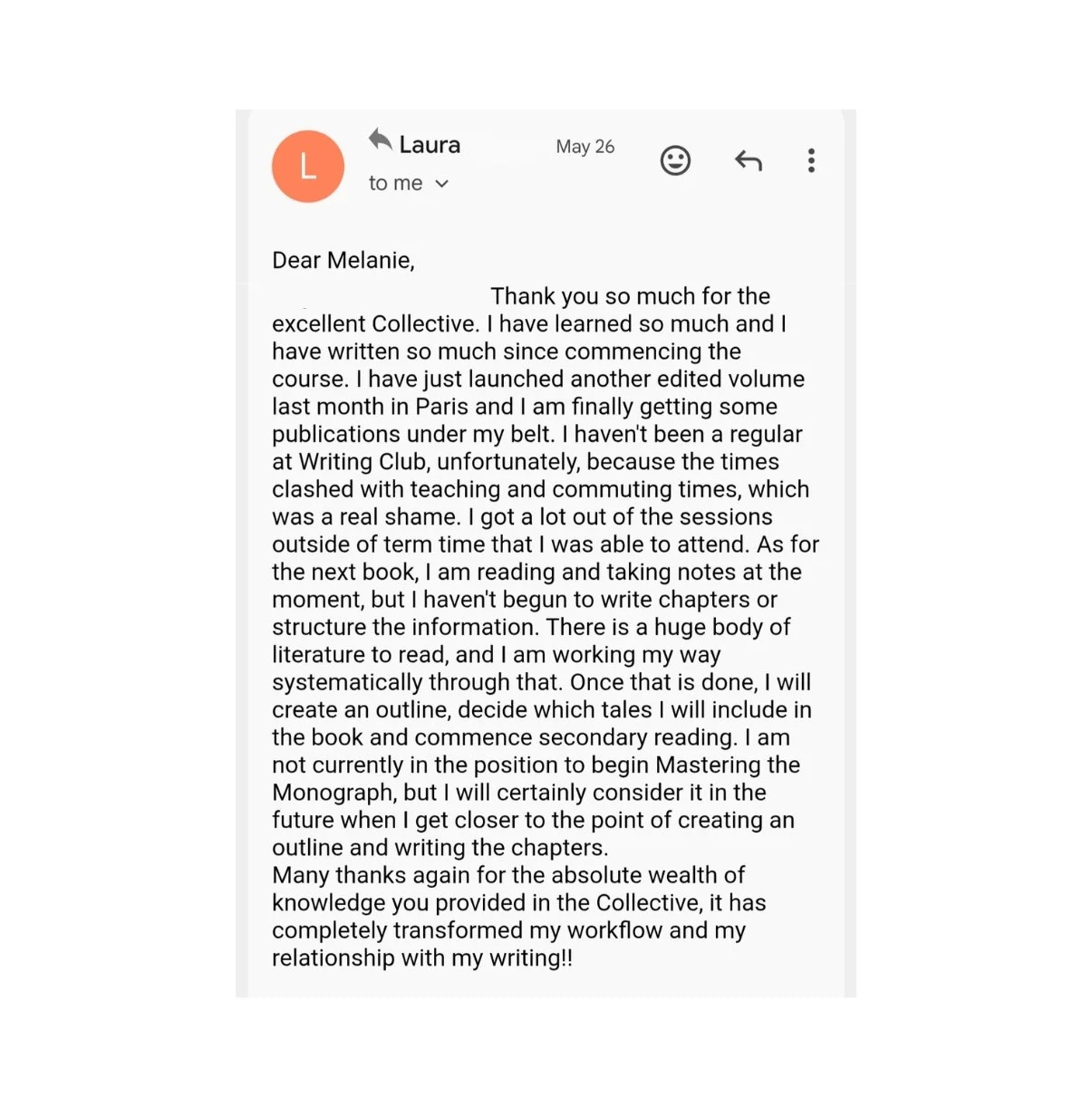
“I have learned so much and I have written so much since commencing… I have just launched another edited volume… and I am finally getting some publications under my belt.”
-Laura
See more book-writing experiences
-
“That was the easiest paragraph to write!!!”
-
“a happier academic.”
COMPLETING A PhD
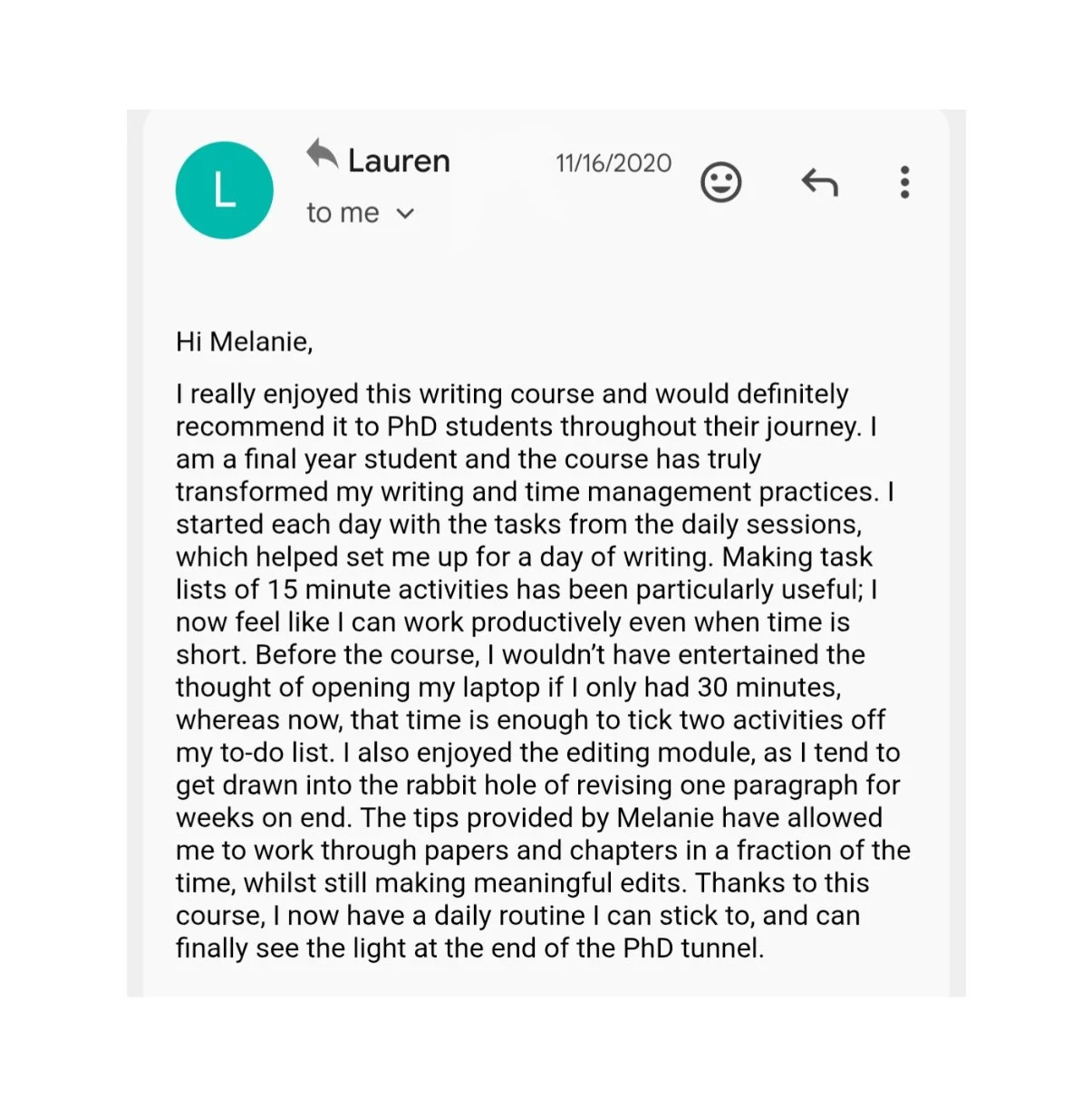
“Before the course, I wouldn’t have entertained the thought of opening my laptop if I only had 30 minutes, whereas now, that time is enough to tick two activities off my to-do list.”
-Lauren
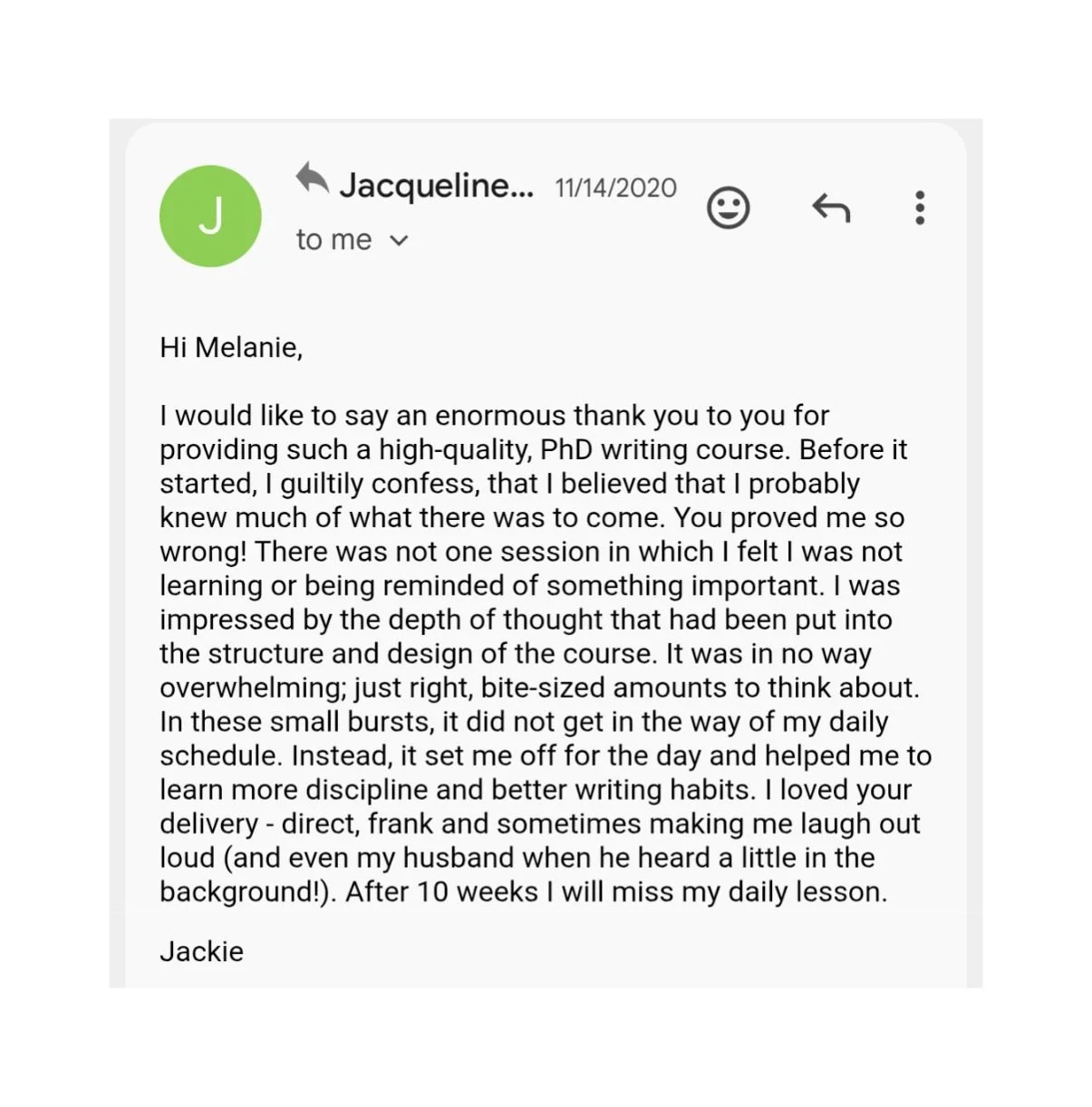
“There was not one session in which I felt I was not learning or being reminded of something important.”
-Jacqueline
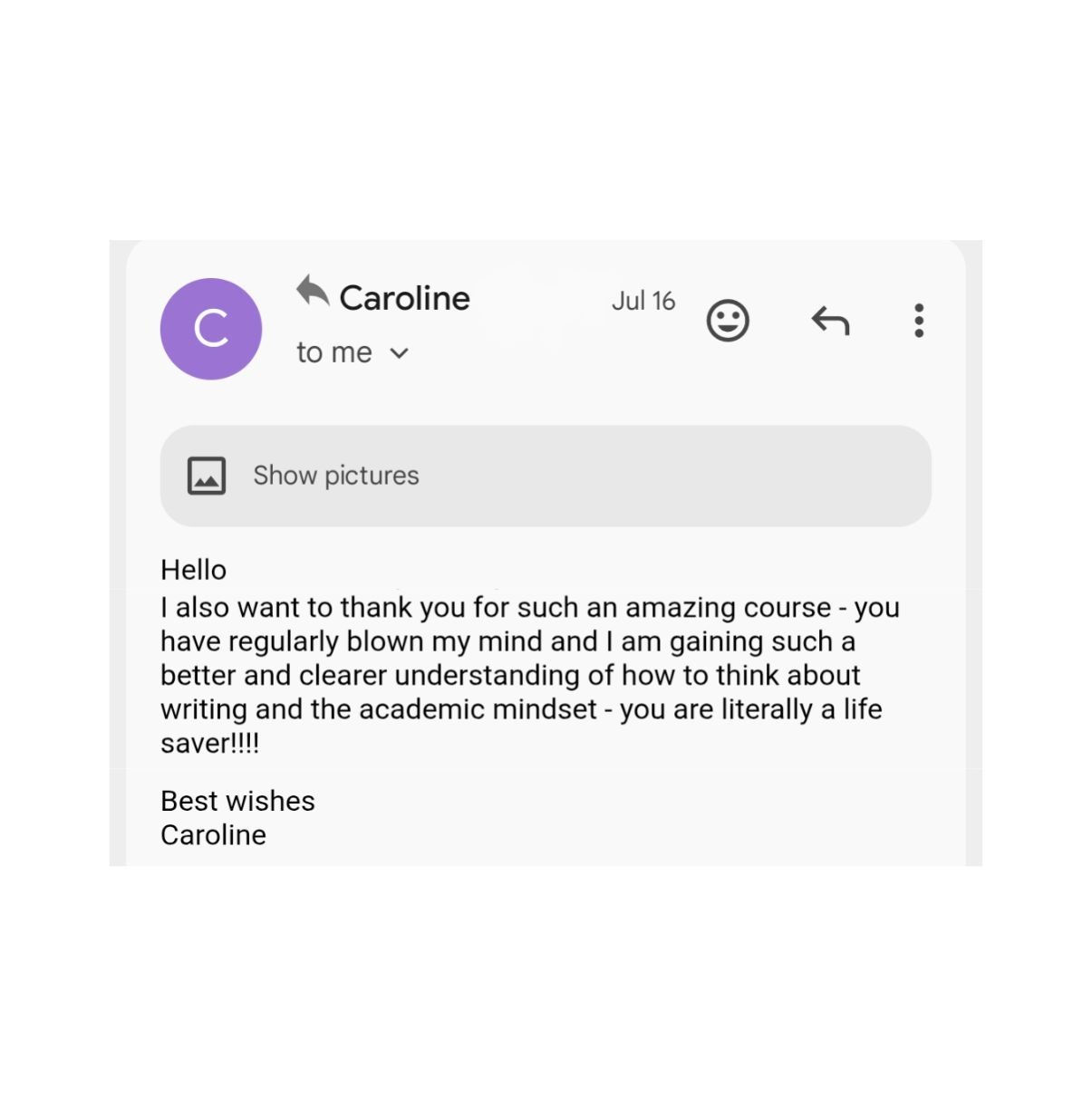
“I am gaining such a better and clearer understanding of how to think about writing and the academic mindset.”
-Caroline
See more pHD STORIES
-
“I entirely recommend this course, and am sorry I did not find it sooner in my PhD journey.”
-
Particularly useful non-native-English-speaker perspective.
-
Writing retreat was “useful, practical, clear.”
-
“It has given me a focus. I am writing this week with clear goals.”
-
Useful reinforcement/editing/writing-retreat experience.
ACADEMIC CAREER DEVELOPMENT
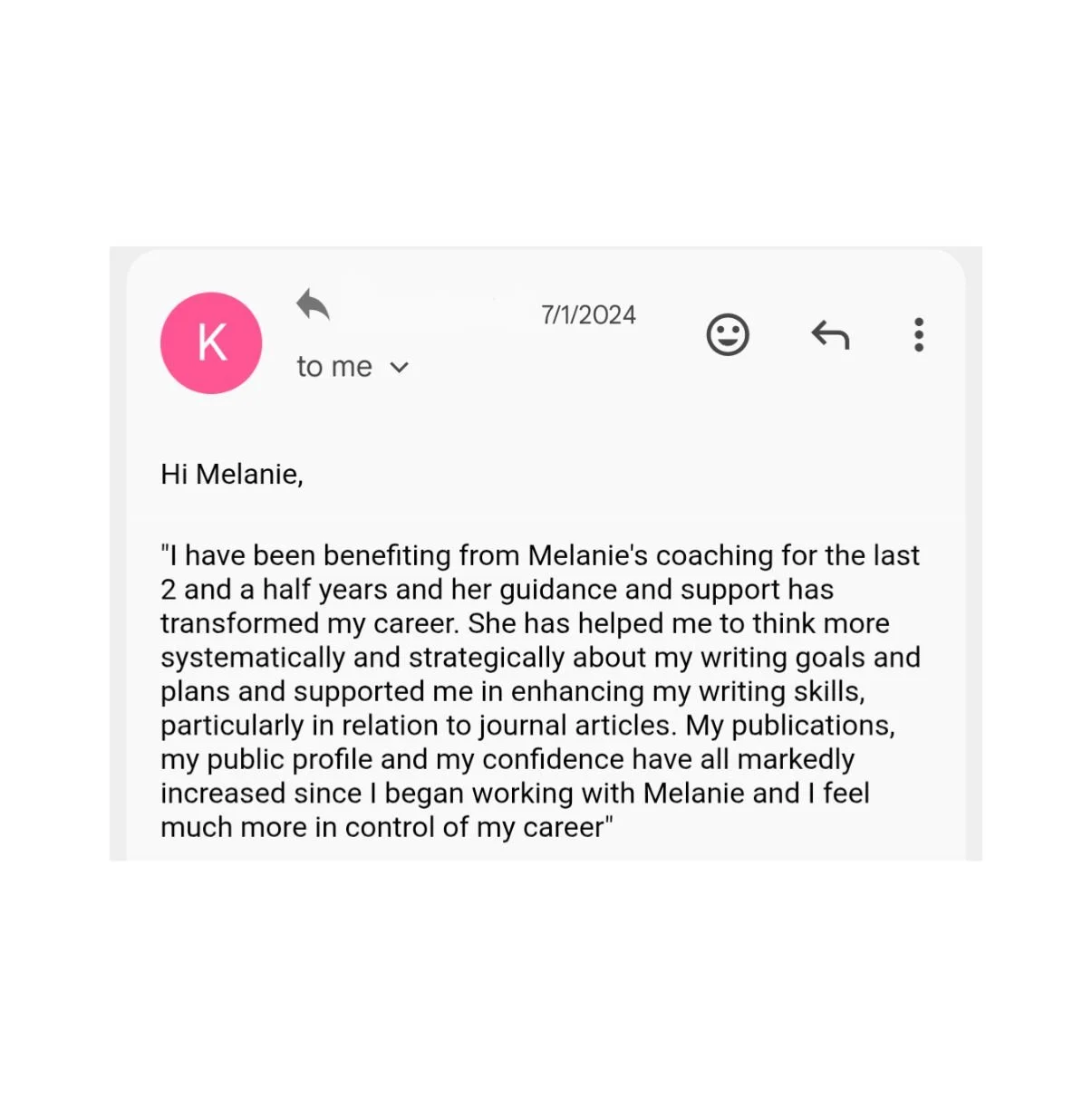
“My publications, my public profile and my confidence have all markedly increased since I began working with Melanie and I feel much more in control of my career.”
- Anonymous (long-term client)
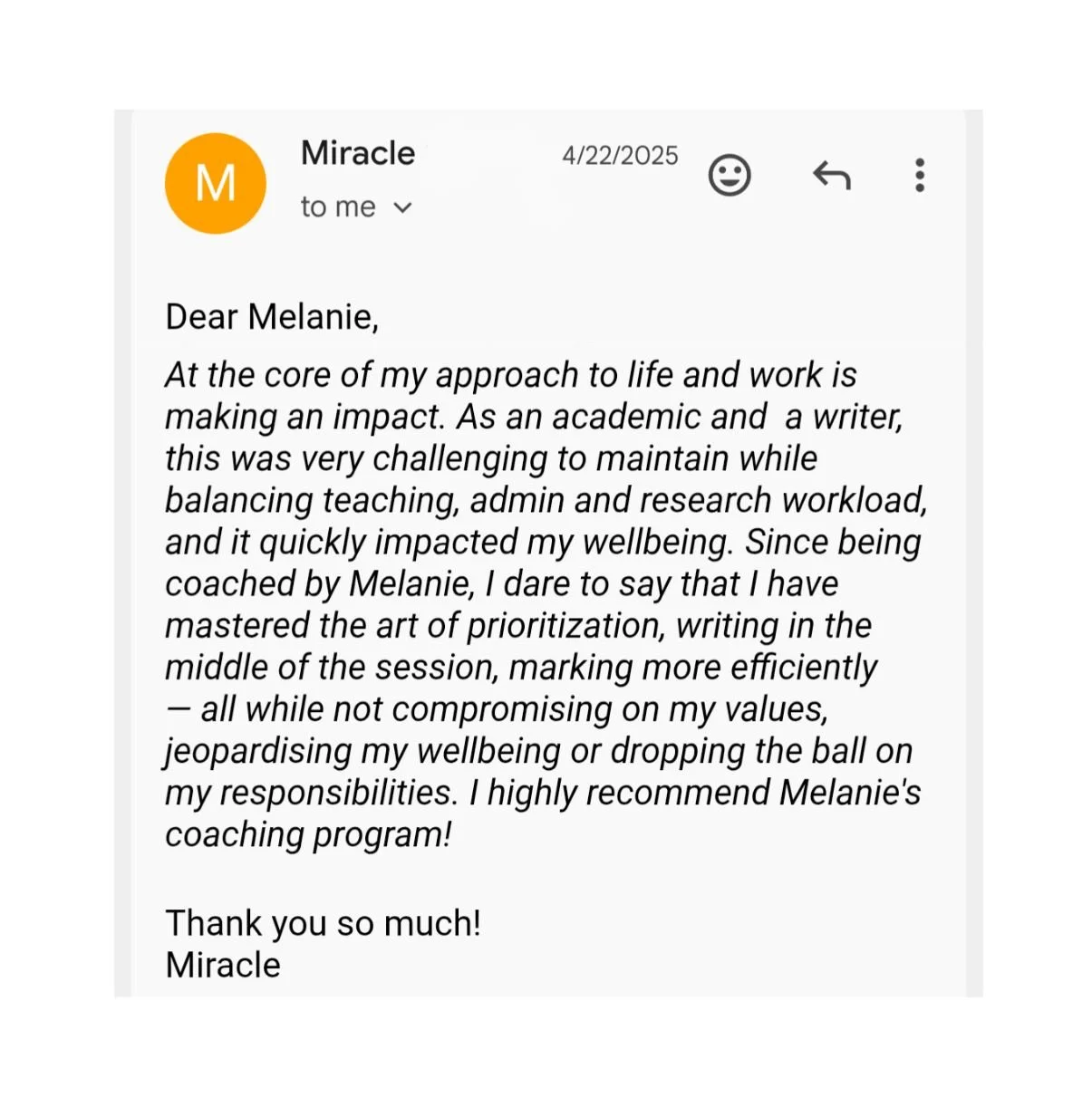
“Since being coached by Melanie, I dare to say that I have mastered the art of prioritization… all while not compromising on my values, jeopardising my wellbeing or dropping the ball on my responsibilities.”
-Miracle
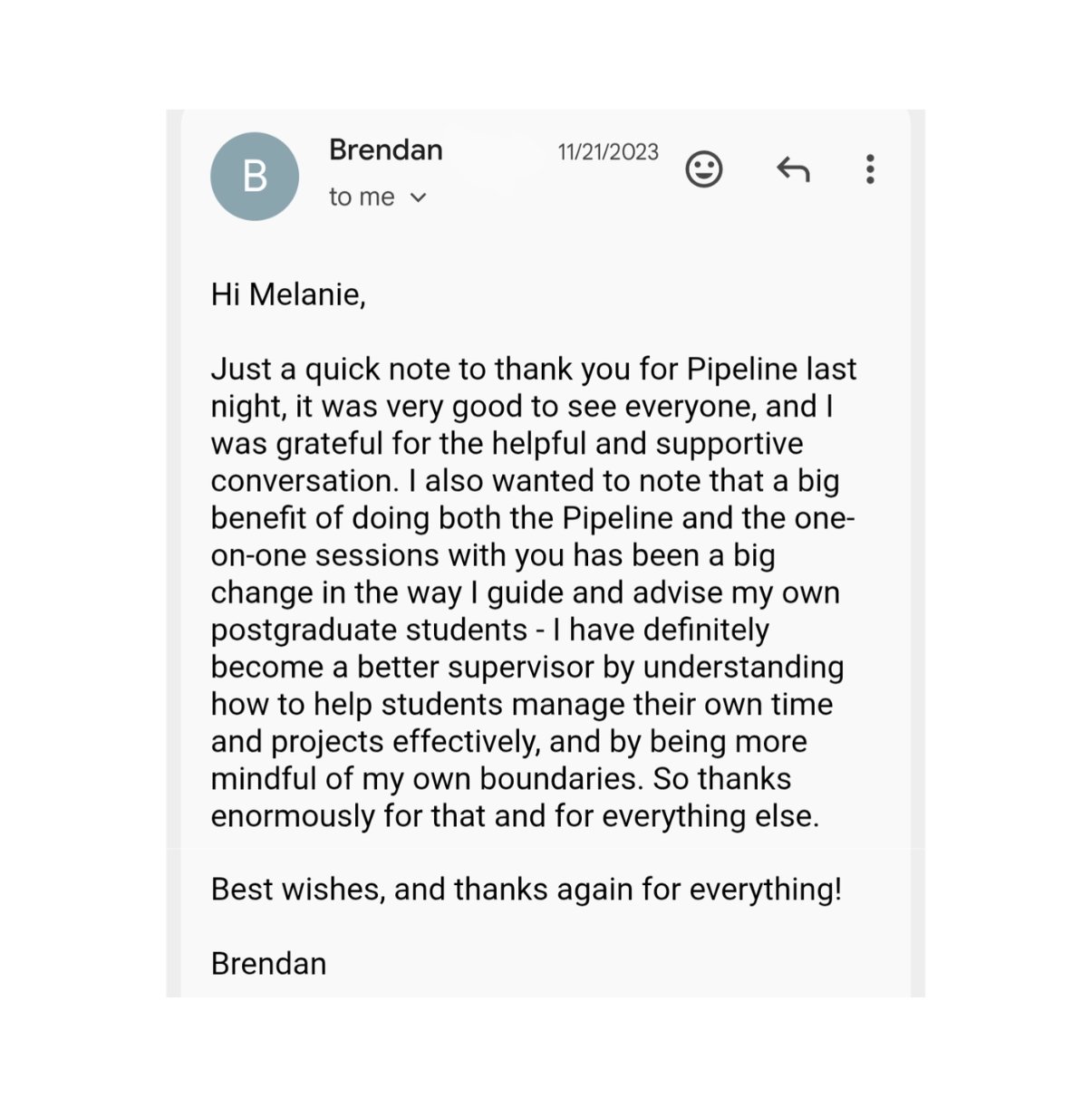
“A big benefit… has been a big change in the way I guide and advise my own postgraduate students — I have definitely become a better supervisor…”
-Brendan
See more career outcomes
-
Saying no to things not aligned with goals + networking + putting herself out there in her field.
-
Successful academic who moved from self-doubt/no system to writing in small chunks and finding writing a source of confidence and joy.
-
Published book + tenure but still “blindly stumbling”; now sees research/writing as “a series of solvable problems.”
-
Returning to research after years in teaching-only positions; confidence and action.
-
Postdoc; changed approach to writing and work more generally.
-
Clarity and intention in research despite academic pressures/time constraints.
-
Completed paper + submitted grant application and “in a so much better place” than six months earlier.
UNIVERSITIES & RESEARCH TEAMS
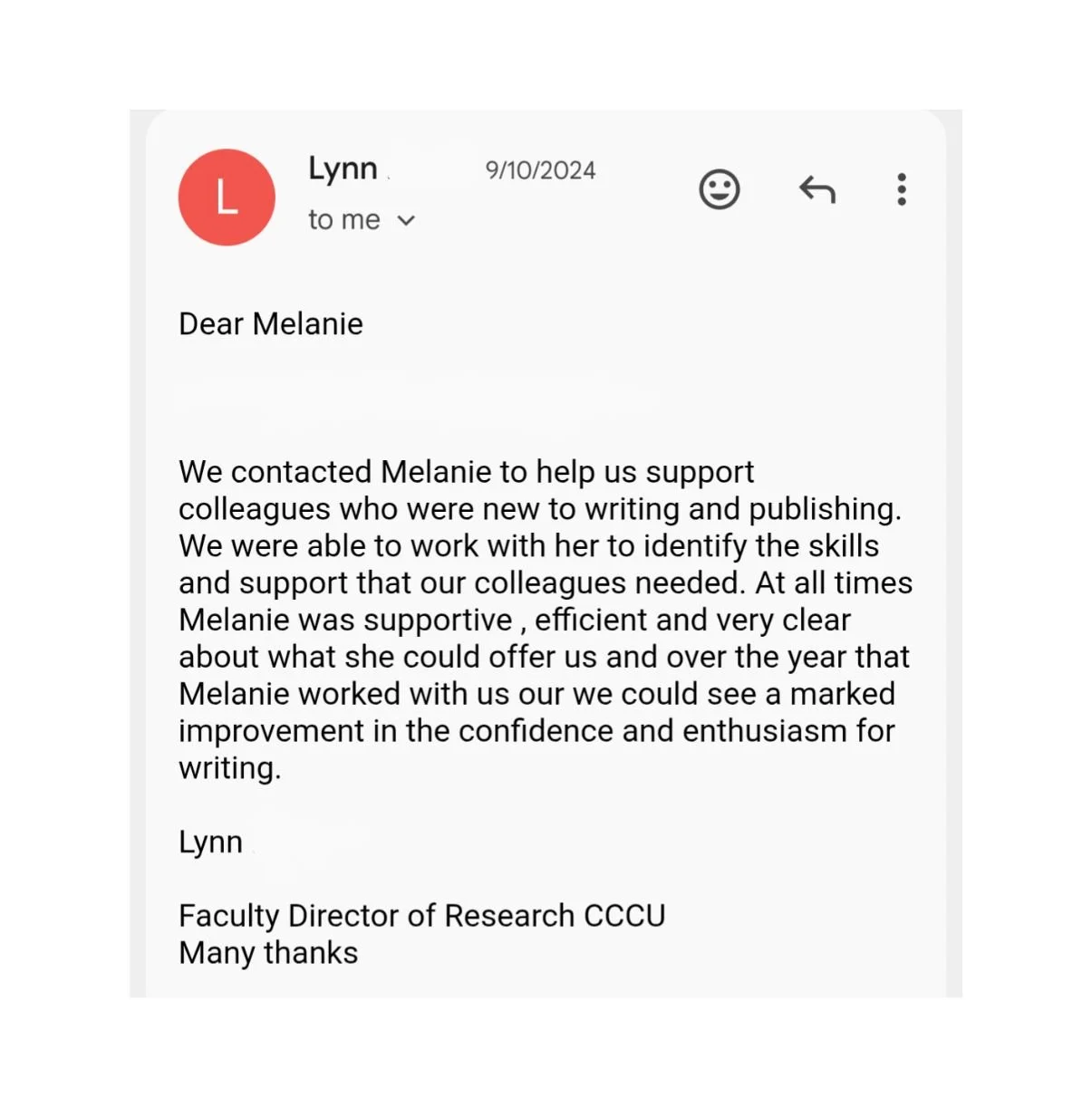
“Over the year that Melanie worked with us we could see a marked improvement in the confidence and enthusiasm for writing.”
-Lynn
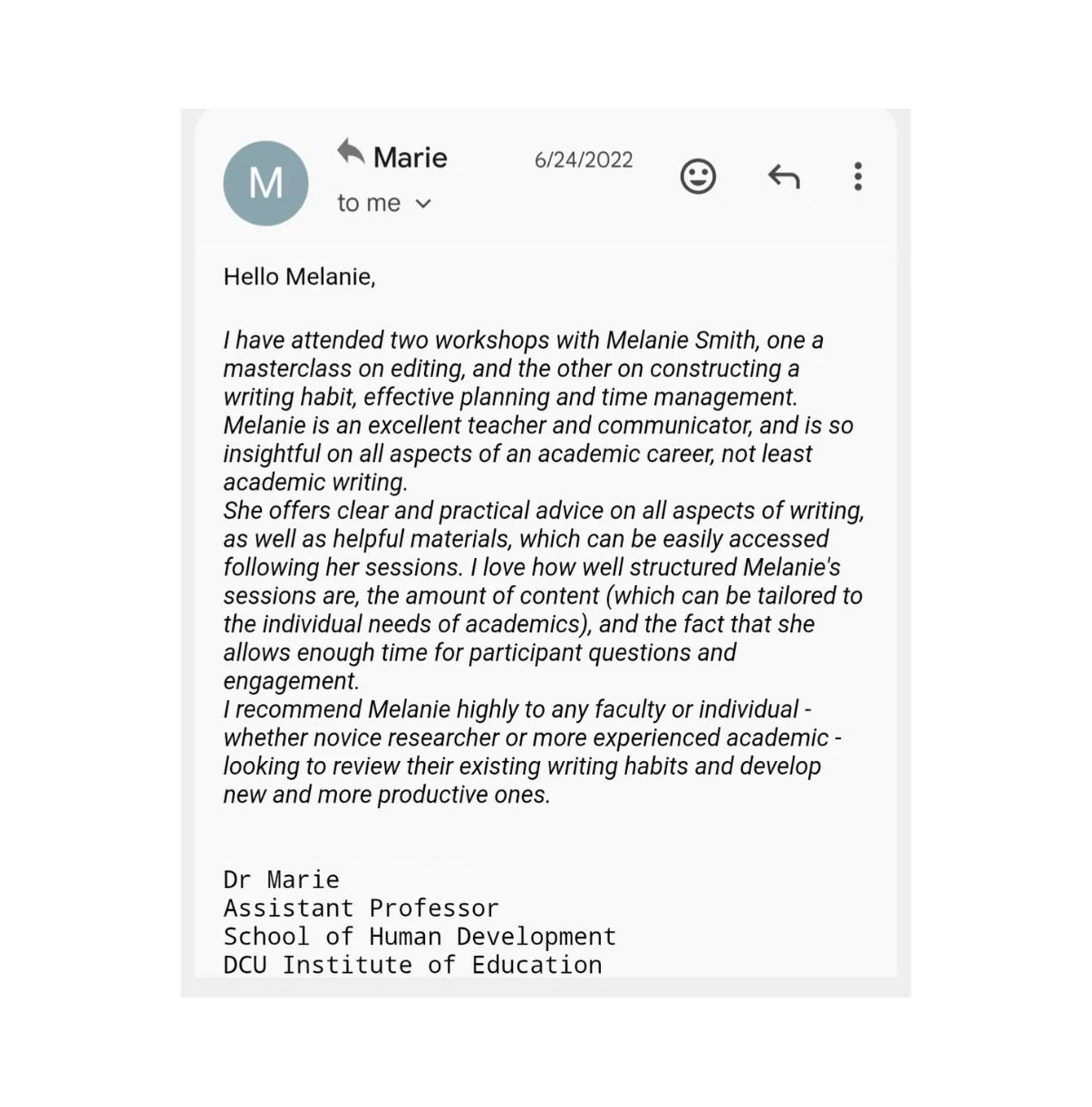
“I love how well structured Melanie’s sessions are, the amount of content (which can be tailored to the individual needs of academic departments)….”
-Marie
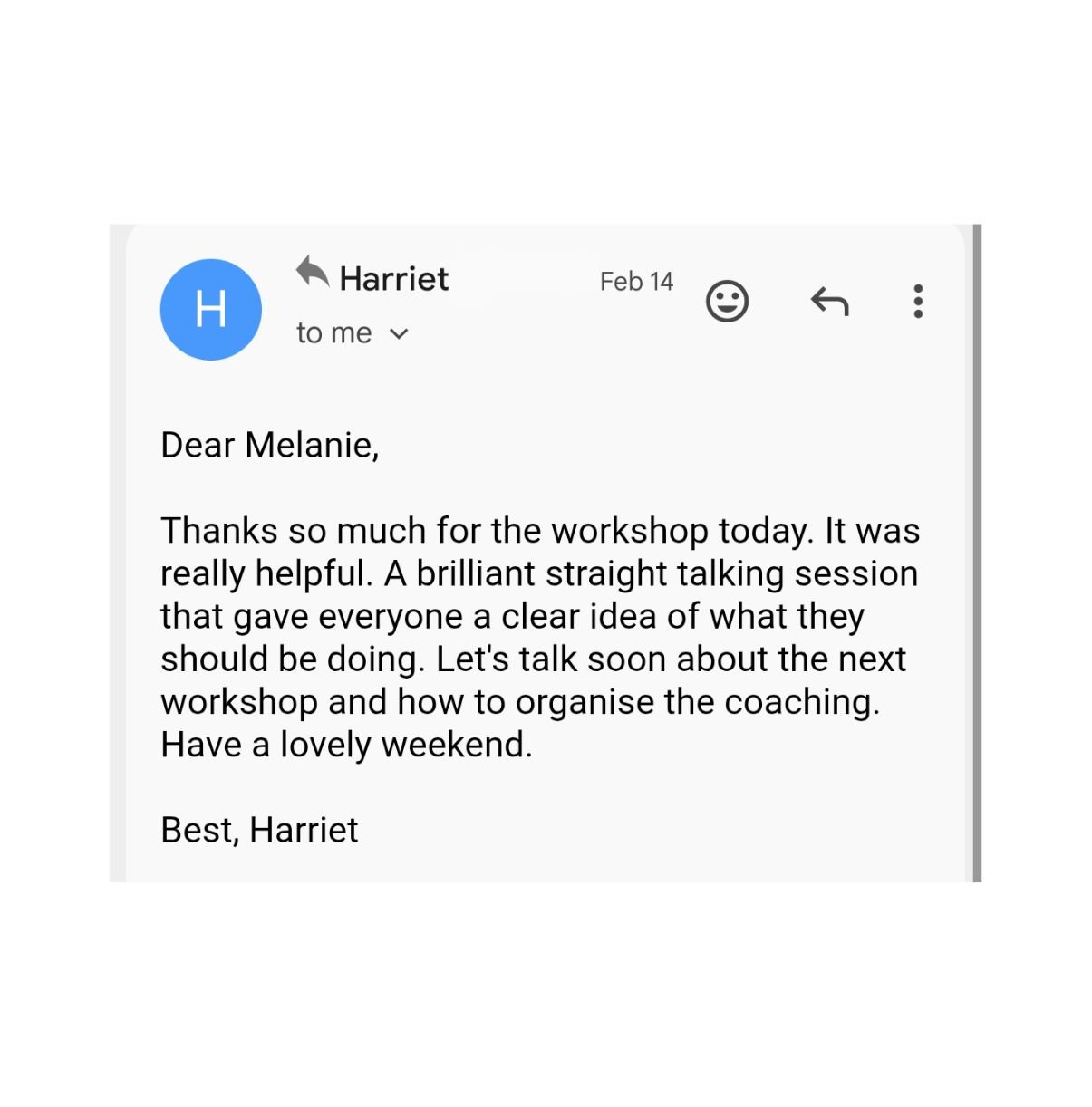
“A brilliant straight talking session that gave everyone a clear idea of what they should be doing.”
-Harriet
See more university feedback
-
“Many still talk about the tips and strategies… and now use [them] in their research planning.”
-
Excellent teacher and communicator
-
There is a clear before and after once you introduce Melanie's processes into your writing practice…
-
Journal writing broken into “practical, manageable steps” with focus on higher-quality outputs/impact.